
Gas Leak Repair Chicago, IL — Fixed Right, Tonight.
Licensed 24/7 gas leak repair in Chicago for the buildings this city actually has — balloon-frame bungalows, hundred-year-old two-flats, greystones, and high-rises. Pressure-tested twice. Permits handled. We do this every day.
⚠ If you smell gas right now
Do these three things before anything else — including calling us.
- Leave the building immediately. No switches, no phones indoors, no open flame — natural gas is lighter than air and collects overhead.
- From outside, call the utility or 911. Peoples Gas: 1-866-556-6002 • Nicor: 1-888-Nicor4U.
- Then call us. We repair everything on your side of the meter — day or night.
Gas Leak Repair in Chicago, IL
Chicago’s housing stock — century-old black iron under Portage Park bungalows, unit-by-unit renovations stacked into Lakeview walk-ups, three-flat meter banks in Bridgeport basements — is hard on gas systems. Gas leak repair in Chicago, IL is one of the most common emergency service calls in Cook County, and for good reason. Between winter contraction working hundred-year-old threaded joints loose, renovation crews vibrating marginal fittings one wall away, and galvanized branch lines corroding from the inside where nobody can see it, gas leaks are simply part of owning property in this city.
We’ve been fixing them from the bungalow belt to the lakefront — greystones off Logan Boulevard, courtyard buildings a block from the Red Line, ranch houses backing the Metra tracks in Beverly. We know these basements. We know Peoples Gas’s rules and the restoration paperwork by heart. We know this city — and every price we charge is published on this site before you ever pick up the phone.
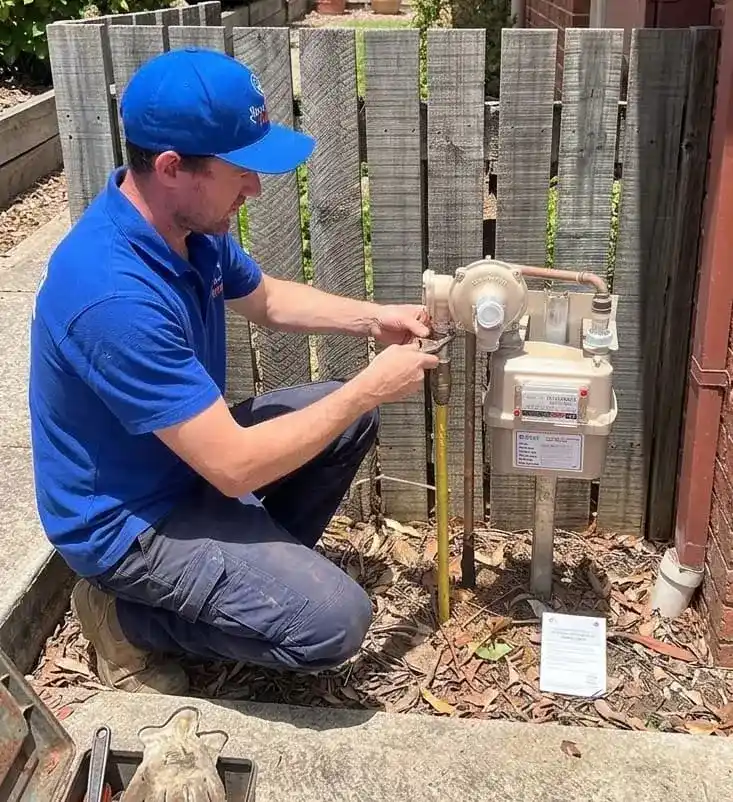 On the job — Chicago, IL
Gas Leak Repair That Understands Chicago’s Old Bones
Chicago runs on one of the oldest gas systems and oldest housing stocks of any major U.S. city — Peoples Gas has publicly acknowledged parts of its network are over a century old, and the buildings it feeds are just as old. That’s why gas leak repair in Chicago is its own trade here, not a line item on an HVAC menu. A rotten-egg smell in your kitchen, a hiss near the meter, a bill that made you look twice: those aren’t rare events in this city. They’re the predictable result of black iron pipe, century-old fittings, and winters that punish both.
- ✓A hissing valve in Logan Square. A corroded underground line in Beverly. A landlord stalling in Albany Park. We’ve seen it — and fixed it.
- ✓Every repair verified before we leave — compressed-air pressure test plus a soap-bubble check at every joint we touched.
- ✓Utility coordination handled. If Peoples Gas red-tagged your meter, we get the repair, permit, and inspection done so they can turn you back on.
Gas Leak Repair Services Chicago Homes Rely On
The full range of gas leak repair services Chicago property owners actually need — residential, multi-unit, and commercial. Small job or big job, we do this every day.
Emergency Gas Leak Repair
24/7 response when you smell gas, hear a hiss, or the utility shuts you off. Chicago-only, so we’re not driving in from a distant suburb.
Leak Detection & Pressure Testing
Compressed-air isolation testing that finds the exact fitting — not the general area. Standard test typically $75–$150.
Gas Line Repair & Replacement
Corroded black iron, failed risers in two-flats and three-flats, seized fittings freed with heat and patience — not brute force.
New Gas Line Installation
Stoves, dryers, water heaters, garage heaters. Chicago install average runs $559, permit around $75.
Outdoor Grill & Patio Gas Lines
Permanent grill lines with a proper regulator and shutoff valve — the two parts that keep backyard grilling safe. Book before grilling season.
Commercial & Industrial Gas Lines
Warehouses, restaurants, multi-unit buildings — including large-diameter work like 4-inch runs reducing to 3-inch. We do the big stuff too.
CSST Inspection & Bonding
The yellow flexible line needs proper electrical bonding — unbonded CSST can arc and perforate in a lightning strike.
Valves, Regulators & Connectors
Shutoff valves, appliance regulators, and old corrugated connectors replaced to current code — the most common leak points we find.
Red Tag Resolution
Repair, permit, pressure test, city inspection, utility callback — the full chain that gets shut-off gas legally restored.
Meter Relocation & Manifolds
For renovations, basement conversions, and multi-unit metering — pre-assembled on a pipe vice, tested before install.
What Are the Signs of a Gas Leak in a Chicago Home?
Natural gas is naturally odorless — utilities add a chemical called mercaptan specifically so you can smell trouble before it becomes dangerous. Take more than one of these at once seriously.
Rotten egg smell
Especially near the stove, meter, or basement — that’s the mercaptan odorant doing its one job: warning you.
Hissing or whistling
Near a pipe, valve, or appliance — even when nothing is running. Larger leaks are often audible.
Bubbles in standing water
Puddles or mud bubbling near where a gas line runs underground — gas escaping through soil.
One dead patch of grass
Yellowing plants in one specific strip with no other explanation — leaking gas starves roots of oxygen. Classic buried-line sign.
An unexplained bill spike
A jump in your gas bill with no cold snap and no new appliance behind it. Small leaks bleed money for months.
Yellow or orange flame
A healthy gas flame burns blue. Yellow or orange on a stove or furnace means incomplete combustion — a warning, not a color preference.
Gas Leak, Sewer Gas, or Carbon Monoxide — Which Is It?
Three very different problems that get confused constantly — and getting it right changes what you do next. Sewer gas from a dry floor drain trap fools more Chicago homeowners than anything else.
| Factor | Natural Gas Leak | Sewer Gas | Carbon Monoxide |
|---|---|---|---|
| Smell | Rotten egg / sulfur | Rotten egg, more sewage-like or musty | No smell at all |
| Common source | Gas line, appliance connector, meter | Dry drain trap, cracked sewer pipe or flange | Furnace, water heater, stove — incomplete combustion |
| Where it shows up | Near appliances, meters, basements | Near floor drains, basements, bathrooms | Anywhere air circulates — often bedrooms overnight |
| Detected by | Combustible-gas meter (not your CO alarm) | Air-quality testing for hydrogen sulfide | CO alarm — required near sleeping areas by Chicago ordinance |
| Immediate danger | Fire, explosion | Unhealthy, not typically explosive residentially | Poisoning — can be fatal with zero warning smell |
| What to do | Leave, then call your gas utility | Call a plumber to check traps and sewer line | Leave immediately, call 911 |
A combustible-gas detector and a CO alarm answer different questions — one finds methane, the other finds carbon monoxide. We carry both. If your CO detector is sounding, that takes priority over everything: evacuate first, sort it out after.
Grade 1, 2, and 3 Gas Leaks — and What a Red Tag Means
When Peoples Gas or Nicor responds to a leak call, they classify what they find. Knowing the grade tells you how urgent your situation actually is — and what happens next.
GRADE 1 Existing hazard
Gas in or migrating toward a building. The utility responds immediately, shuts off gas, and clears the area if needed. Repair cannot wait — this is the leave-the-house scenario.
GRADE 2 Future hazard
Not an immediate danger, but it will become one. Repair is required on a schedule, and the leak is rechecked until it’s fixed. Don’t let a Grade 2 sit — Chicago winters turn them into Grade 1s.
GRADE 3 Monitored
Non-hazardous at current levels — monitored and re-evaluated over time. Often the quiet bill-creep leaks that go months unnoticed in older piping.
🔴 Red-tagged by the gas company? Here’s the exact path back.
A red tag means the utility found a hazard on your side of the meter and shut off gas to that line or appliance. It legally stays off until a licensed contractor repairs the problem, the work holds a pressure test, and — where required — the City of Chicago inspects it. Then the utility restores service. We handle that entire chain: repair, permit, test, inspection, utility callback. One call, not five.
Why Are Gas Leaks So Common in Chicago?
Not a generic problem — three forces almost unique to this city, and a season that makes all three worse.
Genuinely old buildings
Bungalows across the Southwest and Northwest Sides went up largely 1910–1940 with balloon-frame walls — continuous stud cavities where a leak can travel a full story before surfacing. The city’s two-to-four-flats have a median age around 108 years: original black iron, installed before current code existed.
Brutal freeze-thaw cycles
Chicago’s frost line runs several feet deep, and every winter the ground above it shifts as lake-effect deep freezes give way to thaws. That movement stresses buried service lines and exterior fittings; masonry cracks open new paths for migrating gas.
A century-old gas network
Peoples Gas has openly acknowledged running distribution mains over a century old in parts of the city, and its long-running pipe replacement program has been public record — and public debate — for years. Old mains mean more odor calls that turn out to start underground.
How Gas Problems Move Through a Chicago Year
Timing is the difference between a scheduled afternoon repair and a 9pm emergency in single-digit cold. This is the rhythm we plan around — and you can too.
Oct–Nov · Pre-Freeze Window
The smart season: pressure tests ($75–$150), marginal-joint repairs, and meter checks before contraction hits. The October checklist takes an hour and skips the January queue.
Dec–Feb · Contraction Season
The deep freeze works century-old threaded joints like a slow wrench — leak calls peak in the first hard cold snap while sealed windows concentrate every escaped cubic foot.
Mar–Apr · The Thaw Reveals
Frost heave has been stressing shallow buried lines all winter; melting snow uncovers dead-grass strips over garage runs and rust that hid under ice at the meter set.
May–Sep · Dig & Build Season
Construction and landscaping strike buried lines (call 811 first — it’s free and it’s the law), while grill lines, generator runs, and rehab projects fill the install calendar.
What Are the Health and Financial Risks of a Gas Leak?
The health case for prompt gas leak repair in Chicago is written in carbon monoxide statistics — and the financial case is written in insurance exclusions and fire-loss data.
Carbon monoxide: the silent killer
CO from incomplete combustion causes hundreds of accidental deaths and tens of thousands of ER visits in the U.S. every year, per CDC data — and the deaths cluster in the heating months, roughly September through April. Chicago was one of the first U.S. cities to require CO alarms near sleeping areas, back in 1994, and city health officials still issue CO warnings every heating season for good reason.
What exposure feels like
Headache, dizziness, nausea, fatigue, confusion — symptoms that mimic the flu without the fever, and that ease when you leave the house. In enclosed spaces, a large leak can also displace oxygen outright. Multiple-person hospitalizations from a single building’s faulty furnace or boiler recur in Chicago every winter. If several people or pets feel sick at once, treat it as exposure and get out.
The money side
Nationally, NFPA analyses attribute thousands of U.S. home structure fires each year to natural-gas ignition, with well over a hundred million dollars in annual direct property damage. Locally, a 2024 PSE Healthy Energy study put Chicago’s emergency-response cost for uncombusted leaks at over $4.5 million a year in taxpayer money. And at your own address: insurers often treat sudden events and gradual corrosion very differently — slow leaks you ignored can become the claim that isn’t covered.
Real Chicago-Area Gas Explosions and Incidents
These aren’t scare stories — they’re documented events and published findings from this market. We include them for one reason: every single one was preventable, and each changed something about how careful gas work gets done here.
A house explosion that leveled a home
A gas explosion destroyed a residence and damaged more than ten neighboring structures in a single blast — one of several recent Chicago-area incidents where an unaddressed leak in an enclosed space found an ignition source. The lesson never changes: a leak you can smell is a countdown you can stop.
The same pattern, different addresses
Separate house explosions in Crestwood and in Woodstock (McHenry County) followed the pattern investigators cite most: gas accumulating out of sight, then a switch, a pilot, a spark. Total-loss events — and the reason “it’s probably nothing” is the most expensive sentence in this trade.
Excavator breaches an 8-inch gas main
A construction crew digging on Howard Street struck a buried Nicor main. The road closed, the area was cleared, and fire crews staged with hose lines ready while utility techs monitored for vapor. Nobody was hurt — because the response followed protocol. It’s why Illinois’s 811/JULIE locate law applies to every dig, including ours.
Polar vortex pipe failures
Sustained double-digit-below-zero cold drove citywide spikes in pipe and fitting failures, hitting pre-1960 balloon-frame homes hardest — the ones with lines running through uninsulated exterior wall cavities.
$4.5M a year in leak response
A 2024 PSE Healthy Energy study put the emergency-response cost of uncombusted gas leaks in Chicago at over $4.5 million per year in taxpayer money — fire crews answering leak calls alone, before any property damage.
A network past its 100th birthday
The utility itself has acknowledged parts of its system are over a century old. Its modernization program has replaced mains for years — but the oldest housing stock still sits on the oldest infrastructure.
Who’s Responsible — You or the Gas Company?
The meter is the dividing line. Here’s the plain-English version of how the law splits it — because “the gas company came out but didn’t fix it” is the single most common confusion in this city.
Before the meter — the utility’s job
- Peoples Gas (city) or Nicor (north/west suburbs) own and monitor everything from the street main to your meter
- A leak on their side gets fixed by them — free of charge
- A leak on your side gets isolated and shut off — then they hand you a list and tell you to call a licensed contractor
After the meter — your responsibility
- Every pipe feeding your furnace, water heater, stove, and dryer is yours to maintain
- Illinois law requires a licensed contractor for this work — it is not a gray area like a dripping faucet
- Chicago requires a permit and inspection before gas is restored — we handle both as standard
This split is governed by the Illinois Commerce Commission’s Gas Pipeline Safety Program under Illinois Administrative Code Title 83. It isn’t a runaround from the utility — it’s how responsibility is divided by law.
What Happens When You Call for Gas Leak Repair?
The exact sequence, every job. The photo on the right is the part cheap repairs skip: verification testing under pressure — the step that proves the fix held before we leave. One Chicago-area homeowner’s story we keep in mind: $4,000 paid to another outfit for elbow fittings that still wouldn’t hold pressure afterward. That’s what skipping verification costs.
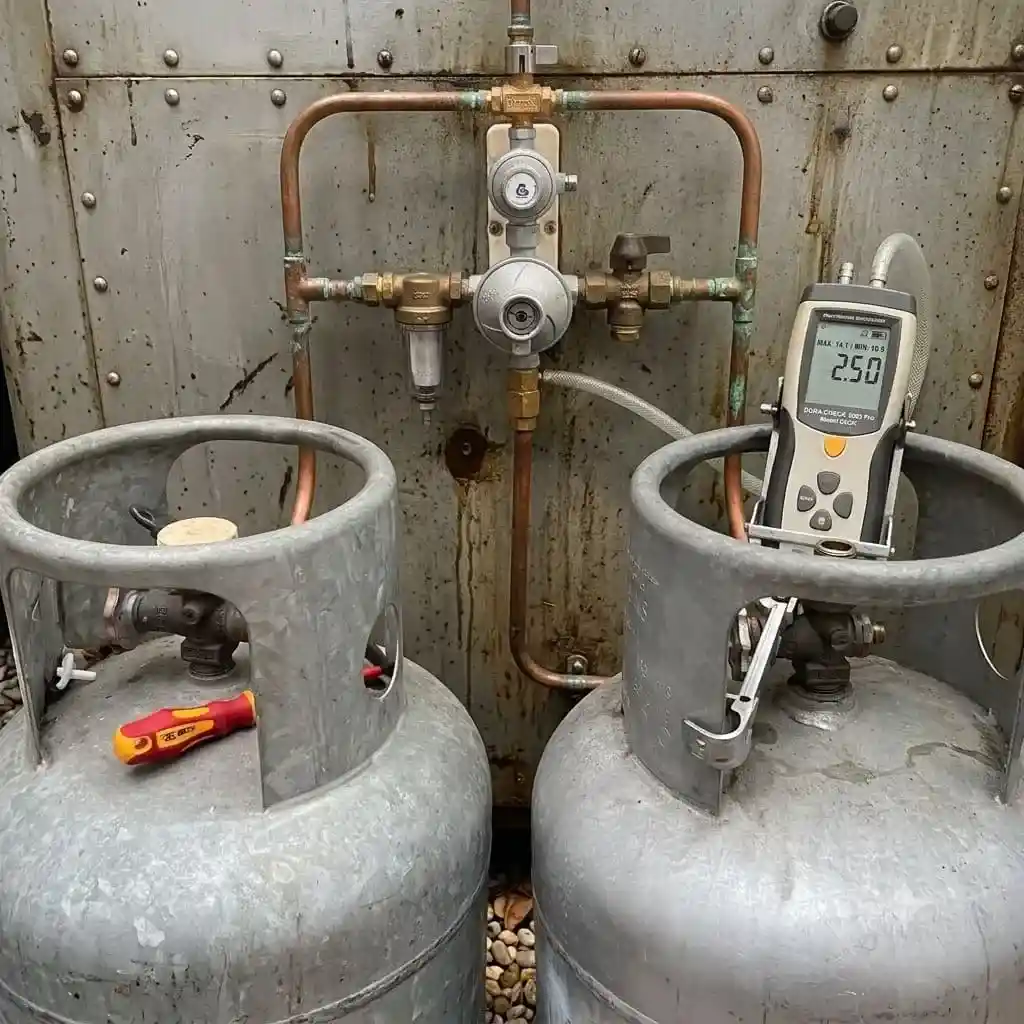 Pressure verification — standard on every job
You call, we ask the right questions
Anyone smelling gas right now? Area safe? Has the utility already been out — and did they tag anything?
We pinpoint the exact location
Compressed-air pressure testing isolates the specific fitting, joint, or pipe section — not just “somewhere in the house.”
We repair or replace what failed
Re-sealing with gas-rated compound, swapping corroded black iron, replacing a flex connector, or a full underground section.
We pressure-test again to confirm
The line holds pressure, then a soap-bubble check at every joint we touched. Bubbles mean not done. No bubbles, we’re done.
We handle permit & utility coordination
Chicago permit, city inspection where required, and the utility callback — squared away so your gas gets restored without a second round of calls.
We show you exactly what we found
What failed, why it failed, and what we did about it — in plain terms, not invoice jargon.
The Small Details That Tell You a Gas Fitter Is Real
Anyone can list services. These are the habits that separate gas work that lasts fifty years from gas work that leaks again next winter.
Gas-rated pipe compound, not bargain sealant
Thread compound rated for natural gas and petroleum costs more — and done right, that joint is good for fifty years. Generic sealant is where next winter’s leak comes from.
Heat and patience on seized fittings
An 80-year-old corroded nipple comes off with controlled heat — expansion and contraction — not brute force that cracks the next joint down the line.
Pre-assembly on a pipe vice
Manifolds and multi-fitting runs get assembled and tested on the bench, so what goes into your wall is already right before it’s installed.
Proper hanging — no strain on threads
Code requires gas piping supported so threaded joints carry no stress. Sagging, unsupported pipe — hung wrong or never hung at all — is a slow-motion failure we fix constantly.
Anti-corrosion coating on new steel
New exterior pipe gets a rust-inhibiting spray coat before we pack up. A five-minute step that adds decades.
The right meter for the question
A combustible-gas detector finds methane; your CO alarm doesn’t. We carry both, plus gauges — because they answer different questions.
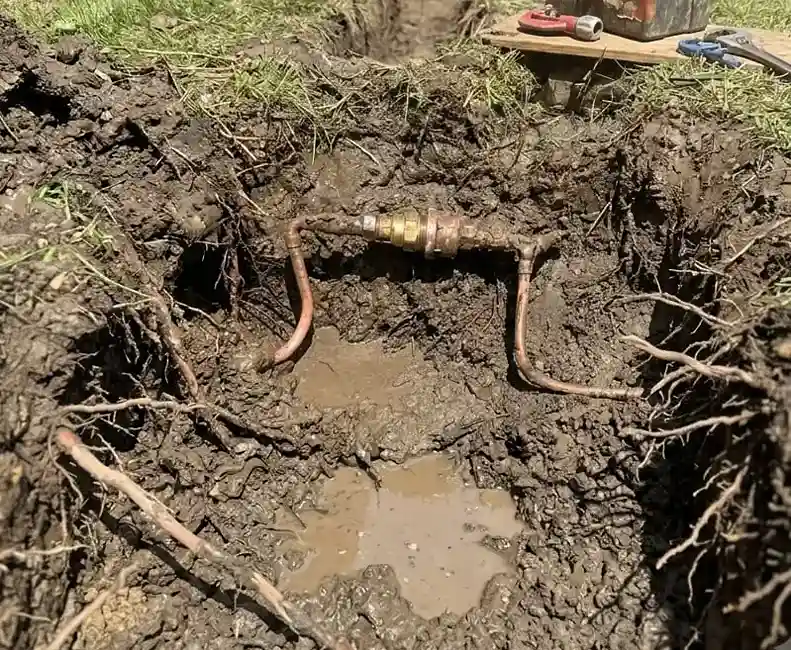 Underground service line replacement
Buried Steel Lines Corrode — Quietly, Then All at Once
The line running from your meter into the house is often original steel — it goes into the concrete, under the ground, and feeds the house, sitting below Chicago’s deep frost line in soil that freezes and heaves every winter. Corrosion eats it from the outside in. The first warning is usually a smell outdoors, bubbles in a wet patch of yard, or one stubborn strip of dead grass.
- ✓We locate before we dig — Illinois’s 811 (JULIE) utility-locate law applies to every excavation, ours included. The Niles main strike is what happens when digging skips that step.
- ✓Honest pricing on excavation work — buried repairs run $1,500–$3,500+ because of real labor, and we quote it before a shovel touches the ground.
Four Gas Leak Calls We Take Every Week in Chicago
Chicago’s housing stock produces the same situations over and over — it’s why we’re the gas leak repair Chicago landlords and homeowners call once the utility hands them a list. If yours is on this list, you’re not unlucky. You’re typical, and the fix is a known road.
The three-flat with a utility list
Peoples Gas inspects, finds leaks at the risers, shuts the gas, and hands the owner a repair list. Tenants have no cooking gas and the clock is ticking under the CRLTO. We repair, pressure-test, pull the permit, and get the utility back out — fast.
The range connector from another era
Rotten-egg smell strongest behind the stove. Behind it: a corrugated connector that predates current code, weeping at the crimp. Replaced with a code-rated connector and a new shutoff, bubble-tested before the range slides back.
The dead strip of grass
One yellow stripe across an otherwise healthy lawn, tracking the buried service line. Soap solution over a wet patch confirms it. JULIE locate, excavate, replace the corroded section, coat against rust, backfill.
The condo riser dispute
A leak on shared piping — and the HOA and a unit owner each think it’s the other’s bill. We document exactly where the leak sits relative to the branch line, so the repair happens now and the cost lands where it should.
Chicago Gas Leak Repair Cost: What You’ll Actually Pay
Most gas leak repair Chicago quotes hide the number until the truck is in the alley. Here’s what the market actually runs — typical ranges, not quotes, and we confirm yours before work starts.
| Service | Typical Cost Range |
|---|---|
| Standard pressure test | $75 – $150 |
| Minor accessible leak repair (fitting, connector) | $120 – $300 |
| Shutoff valve replacement | $250 – $750 |
| Capping an unused line | $50 – $200 |
| Major repair on a buried/underground line | $1,500 – $3,000+ |
| New gas line installation (Chicago average) | $559 (typical range $269 – $850) |
| Chicago gas line permit fee | ~$75 |
| Annual gas system inspection | ~$150 |
What moves the price up or down
| Factor | Pushes cost down | Pushes cost up |
|---|---|---|
| Access | Exposed piping in an unfinished basement | Lines behind finished walls or ceilings |
| Location of leak | At an appliance connector or valve | Buried yard line requiring excavation |
| Pipe condition | One isolated bad fitting | A corroded run needing section replacement |
| Timing | Scheduled weekday work | Night, weekend, or holiday emergency (typically 1.5–2x) |
| Building type | Single-family with one meter | Multi-unit risers, shared piping, HOA coordination |
Why Choose GasGuard Chicago?
Here’s how your actual options stack up when you smell gas — including the ones that aren’t us.
| What you need | GasGuard Chicago | The utility | General HVAC co. | Handyman |
|---|---|---|---|---|
| Repairs past the meter | ✓ Our whole business | ✗ Stops at the meter | ~ A side service | ✗ Not legal for gas |
| Finds leaks up to the meter, free | ~ We start where they stop | ✓ Always call them first | ✗ | ✗ |
| Pulls Chicago permits as standard | ✓ Every job | — N/A | ~ Sometimes | ✗ Rarely |
| Verifies with pressure + bubble test | ✓ Twice, every repair | — Detection only | ~ Varies by crew | ✗ |
| Gas-only specialist focus | ✓ One trade, done right | — | ✗ Gas is a menu item | ✗ |
| Chicago-only response times | ✓ No suburb stretch | ✓ | ~ Metro-wide crews | ~ |
| Publishes real price ranges | ✓ On this page | — | ✗ “Call for quote” | ~ |
To be fair to everyone in that table: always call the utility first in an emergency — that part is free and it’s the law of the land here. Our job starts where theirs ends.
Who Should You Actually Call for a Gas Leak in Chicago?
Three doors people knock on — here’s what’s genuinely behind each one, including where we’re not the right call.
| Peoples Gas (the utility) | Typical plumbing generalist | GasGuard Chicago | |
|---|---|---|---|
| Emergency response | ✅ Free, 24/7 — always your first call for an active smell (1-866-556-6002) | ⚠️ Varies — gas is one of twenty services on the truck | ✅ 24/7, gas work only |
| What they can fix | ❌ Their side of the meter only — private piping gets tagged, not repaired | ✅ Licensed shops can — depth varies by how often they do it | ✅ Everything past the meter: detection to full lines |
| Published pricing | — Free (their side) | ❌ “Call for quote” almost universally | ✅ Every tier on this page before you call |
| Pressure test & affidavit | ❌ Requires it, doesn’t perform it | ⚠️ Often subbed out or billed as an add-on | ✅ $75–$150 with signed affidavit, included in every repair |
| Multi-unit restoration | ❌ Restores accounts one by one as tests arrive | ⚠️ Frequently learns per-account rules mid-job | ✅ All lines tested in one visit, all accounts called in together |
| Permits | — N/A | ⚠️ “Do you really want one?” happens more than it should | ✅ Filed on every job, ~$75, no exceptions |
About GasGuard: Gas Leak Repair in Chicago, Done Properly
Chicago gas leak repair is a trade with no room for guesswork — so GasGuard Chicago was built around one trade, done properly, in one city. Not a franchise stretched across three counties. Not an HVAC company where gas piping is the fourth thing on the truck. Licensed and insured gas fitting for Chicago’s actual buildings, from Beverly’s brick bungalows to River North’s high-rise risers.
- ✓We stand behind our work. Every joint we touch gets sealed with gas-rated compound, hung to code, and verified under pressure before we call it finished — because a repair that isn’t tested isn’t a repair.
- ✓We put the right guys on the job. Two-flat riser work, buried service lines, and commercial runs are different skills — you get the technician who does that exact work every week.
- ✓We explain everything in plain English. What failed, why it failed, what it costs, and what the permit process looks like — before the work starts, not on the invoice.
- ✓Proudly Chicagoland, deliberately city-focused. Staying inside Chicago keeps our response times honest and our technicians fluent in the buildings they’ll walk into.
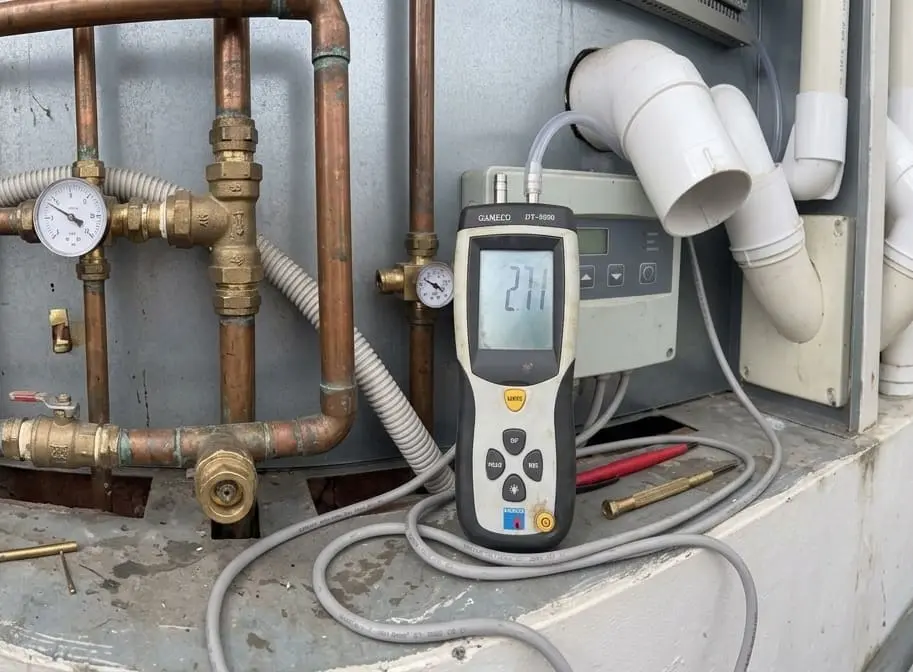 One trade. One city. Done right.
Natural Gas Safety Tips for Chicago Homes
Most of the gas leak repair Chicago crews handle in January started as something small and ignorable in December. Here’s the honest prevention list — Chicago edition, lake-effect winters included.
✅ Do this
- Know where your main shutoff valve is — and keep the right wrench near it. In an emergency, seconds matter.
- Keep snow and ice off your exterior meter. Chicago winters bury and freeze meters and regulators — clear them gently by hand, never with a shovel blade or hot water.
- Install CO alarms near every sleeping area. It’s been Chicago law since 1994 — and it’s the only warning CO gives.
- Call JULIE at 811 before any digging — fence posts, trees, a new patio. It’s free, it’s the law, and the Niles main strike shows why.
- Get a pressure test before winter if your home is pre-1960 — around $150 of certainty before the freeze-thaw season starts working on your fittings.
- Have your furnace and water heater checked each fall — most CO incidents trace back to combustion appliances, not the gas lines themselves.
❌ Never do this
- Never search for a leak with a flame or lighter. It sounds absurd until a fire investigator tells you how often it happens.
- Never attempt a DIY gas repair — no tape, no epoxy putty, no push-fit fittings. It’s illegal on gas piping in Chicago, and it’s how small leaks become explosions.
- Never ignore a pilot light that keeps going out or a flame that’s turned yellow — both are your appliance telling you something’s wrong.
- Never run a grill, generator, or patio heater indoors or in a garage — that’s the classic Chicago winter CO tragedy, every single year.
- Never re-enter a building you evacuated for a gas smell until the utility or fire department clears it. Not for your phone, not for the pets’ leash — call 911 from outside instead.
- Never let a “small” smell ride for the weekend. Grade 2 leaks become Grade 1 leaks — usually at the worst possible time.
Chicago Neighborhoods & ZIP Codes We Serve
A downtown high-rise condo and a hundred-year-old Beverly bungalow are not the same job — different pipe, different failure points, different fix. We work all of it, from the Loop to the city limits.
| Area | Neighborhoods | What we typically find | Key ZIPs |
|---|---|---|---|
| Bungalow Belt (NW) | Portage Park, Jefferson Park, Norwood Park, Edison Park | 1910–1940 balloon-frame bungalows; black iron in exterior wall cavities; freeze-stressed fittings | 60630, 60634, 60641, 60631, 60656 |
| Bungalow Belt (SW) | Beverly, Mount Greenwood, Garfield Ridge | Brick bungalows on original buried steel services; classic dead-grass leak signs | 60643, 60655, 60638 |
| Two- & Three-Flat Corridor | Logan Square, Avondale, Albany Park, Humboldt Park, Pilsen | ~108-year median multi-units; shared risers; old corrugated appliance connectors; CRLTO tenant pressure | 60647, 60618, 60625, 60651, 60622, 60608, 60639 |
| Greystone Areas | Bronzeville, North Lawndale, Kenwood | Masonry greystones; freeze-thaw cracking opening migration paths; meter-room access work | 60653, 60623, 60615 |
| Downtown & High-Rise | South Loop, West Loop, River North, Streeterville | Shared stacks and risers; HOA/management coordination; condo cost-split documentation | 60601–60607, 60610, 60611, 60654 |
| North Side Lakefront | Lincoln Park, Lakeview | Vintage walk-ups and courtyard buildings; mixed-era piping from decades of renovations | 60614, 60657 |
Renting? Your Landlord Can’t Sit on a Gas Leak.
Under Chicago’s Residential Landlord and Tenant Ordinance (CRLTO), a gas outage is classified as a failure to provide essential services — the same legal category as heat and water, treated as an immediate danger to health and safety, with real tenant remedies attached: written notice, repair-and-deduct paths, even alternate housing reimbursement in defined cases. This is general information, not legal advice — the Metropolitan Tenants Organization or Legal Aid Chicago can walk you through your exact rights. And when your landlord finally needs a licensed contractor to get the gas legally restored? That’s us.
What Every GasGuard Customer Can Hold Us To
Our Google and Yelp review pages go live with the business — and every review you’ll ever see there will be from a real Chicago job, named neighborhood and all. Until then, here’s the standard those reviews will measure us against.
⏱ We show up when we said
A real arrival window, a call if anything shifts, and 24/7 means 24/7 — including the polar-vortex nights when you need it most.
📈 The gauge decides, not us
No job is finished until the line holds pressure and every touched joint passes a bubble test. You’re welcome to watch both.
📝 No invoice surprises, ever
The number we quote before work is the number you pay after — and if we find something new mid-job, you decide before we proceed.
Gas Leak Repair in Chicago: Your Questions, Answered
The gas company came out and checked, but didn’t fix it — why?
Because responsibility is split at the meter. Peoples Gas or Nicor will find and isolate a leak, and fix anything on their side for free. If the leak is on your side — inside your home’s piping — that legally requires a licensed contractor. It’s not a runaround; it’s how Illinois law divides responsibility.
Is a small gas leak an emergency?
Treat it as one until a professional confirms otherwise. A “small” leak by smell can still be building toward a dangerous concentration in an enclosed space — and Chicago’s balloon-frame walls let gas travel out of sight. When in doubt: leave first, call second.
What is a red tag from the gas company?
The utility found a hazard on your side of the meter and shut off gas to that line or appliance. It stays off until a licensed contractor repairs it, the work holds a pressure test, and the city inspects where required — then the utility restores service. We handle that whole chain.
What are Grade 1, 2, and 3 gas leaks?
Utility classifications of severity. Grade 1 is an existing hazard — immediate response, gas shut off. Grade 2 will become hazardous and must be repaired on a schedule. Grade 3 is non-hazardous at current levels and monitored. Full breakdown in the section above.
Can I use SharkBite or push-fit fittings on a gas line?
No. Push-fit fittings are rated for water, not fuel gas. Gas piping in Chicago is threaded black iron or properly installed and bonded CSST, done to code by a licensed contractor. A push-fit on a gas line is a leak with a countdown on it.
Does a flexible gas line (CSST) need to be bonded?
Yes. CSST — the yellow flexible line common in retrofits — must be electrically bonded. Unbonded CSST can arc during a lightning strike and perforate, which is a fire ignition path. If your home has it, bonding verification is a quick check we do constantly.
Do you install gas lines for outdoor grills?
Yes — a permanent grill line with a proper regulator and shutoff valve is one of our most common non-emergency jobs. The regulator is the part DIY installs skip, and it’s the part that keeps grilling safe. Book in spring before the season rush.
What smell can be mistaken for a gas leak?
Sewer gas is the most common mix-up — also a rotten-egg odor, but from a dry drain trap or cracked sewer line rather than your gas system. The comparison table above shows how to tell them apart. When you can’t tell: treat it as gas.
Can I test for a gas leak myself?
You can watch for warning signs — smell, hissing, bubbles, dead plants, yellow flames — but there’s no reliable DIY repair, and every licensed pro will tell you the same thing: don’t. A soap-bubble test is how a pro confirms a finished repair; it isn’t a substitute for evacuating if you smell gas.
Peoples Gas showed up unannounced to check my meter — is that legit?
The utility does run periodic leak surveys and meter checks, so it can be. Ask for company ID, and if anything feels off, call the number on your gas bill to confirm before letting anyone in. A legitimate tech will wait.
Why did my whole block smell gas at once?
Occasionally a regional venting or upset event carries odorant across whole neighborhoods — it happens, and it usually resolves. The rule: if the smell is strongest inside your home, treat it as your leak. Leave and call.
How long can a gas leak go undetected?
Small Grade 3 leaks can sit for months — a slowly creeping bill, a faint odor you stop noticing, a houseplant that won’t thrive. That’s the case for a periodic pressure test in any pre-1960 Chicago home: cheap, fast, and it finds what your nose has adapted to.
Does homeowners insurance cover gas line leaks?
It depends on your policy — sudden events (like fire) are treated differently from gradual wear like corrosion, which some policies exclude. We can’t give insurance advice, but we document every repair thoroughly so you have what a claim would need.
Who pays for a leak on a shared meter in a two-flat or condo?
Work on the building’s shared piping is usually a building-wide cost; work on one unit’s branch line is usually that unit’s responsibility. Disputes almost always come down to where exactly the leak sits — which is why we document location precisely before repair.
My refrigerator is “leaking gas” — is that the same service?
Different system, different trade. A fridge leak is refrigerant, not natural gas — that’s an appliance or HVAC technician’s job. We handle natural gas piping: lines, valves, connectors, meters. Happy to point you the right direction either way.
Gas Leak Repair Across Chicago’s Neighborhoods — With a Page for Yours
Every neighborhood’s housing breaks differently, so every neighborhood gets its own playbook — real streets, real building types, real prices. Find yours:
Gas Leak Repair Lakeview
Courtyard buildings, unit turnovers, and meter rooms nobody’s ever labeled — 60657/60613.
Gas Leak Repair Lincoln Park
Renovation era-seams, pre-drywall testing, and condo riser disputes — 60614.
Gas Leak Repair Portage Park
The bungalow belt’s five failure points and garage-line country — 60641/60634.
Gas Leak Repair Bridgeport
Multi-meter two- and three-flats and per-account restorations — 60608/60609.
Gas Leak Repair McKinley Park
Frame-house rim joists, fill-ground trenching, rehab testing — 60609/60632.
Gas Leak Repair Beverly
Three-floor traces, generator lines, deep-lot garage runs on the Ridge — 60643.
Gas Leak Repair Morgan Park
Two housing eras, ridge-grade trenching, pre-purchase testing — 60643/60655.
Gas Leak Repair Hyde Park
Co-ops, courtyard buildings, boiler house-meters — 60615/60637.
Gas Leak Repair Logan Square
Rehab country: era-seams, pre-drywall tests, deconversions — 60647.
Gas Leak Repair Avondale
Cottages and two-flats, galvanized-era diagnosis — 60618.
Gas Leak Repair Wicker Park
Victorians plus aging condo conversions — 60622.
Gas Leak Repair Rogers Park
Courtyard buildings & vintage walk-ups — 60626 / 60645.
Gas Leak Repair Edgewater
Co-ops, high-rises & Andersonville two-flats — 60660 / 60640.
Gas Leak Repair Jefferson Park
Bungalow belt & buried garage lines — 60630 / 60646.
Gas Leak Repair North Center
Gut rehabs & deconversions — 60618 / 60613.
Gas Leak Repair Albany Park
Dense two-flats & courtyard buildings — 60625 / 60630.
Chicago Gas Guides
Who pays in rentals, winter leak spikes, three-flat rules, CO vs. gas — the whole help center.
Not listed yet? We cover every Chicago neighborhood — same published pricing, same-day response, from Rogers Park to Hegewisch. Call (773) 200-2148 and it’s handled.
Don’t Wait on a Gas Smell.
Looking for gas leak repair Chicago, IL can actually count on? Whether it’s a faint odor near the stove or a red-tagged meter, the fastest path back to safe is a licensed pro who knows this city’s buildings, codes, and utilities — and proves the fix with a gauge, not a guess. Emergency gas leak repair in Chicago is what this crew is built for — call any hour, any day.
☎ Call (773) 200-2148 — 24/7 Licensed & insured in Illinois • Chicago-only service • Free estimates on non-emergency work