
Gas Line Pressure Testing Chicago, IL — The Gauge Doesn’t Guess.
The gas line pressure testing Chicago, IL requires for restorations, permits, and closings — and the one honest instrument in this whole trade. Your nose adapts, soap only reaches what you can see, but a calibrated gauge holding steady for the full test window proves the entire system, including every joint buried in walls you’ll never open.
📈 Why today, specifically?
Most pressure tests have a deadline attached. Find yours.
- Peoples Gas shut you off or swapped the meter? A passing test with documentation is your ticket back on — same-day in most cases.
- Closing, inspection, or permit on the calendar? We test around your schedule and hand over the affidavit the same visit.
- Something smells but nothing’s been found? Start with gas leak detection — the test proves systems; detection pinpoints sources.
Gas Line Pressure Testing in Chicago, IL
A red-tagged meter that won’t be restored without one. A closing attorney who wants proof before Friday. A rehab permit that requires it on file. Gas line pressure testing in Chicago, IL is the hinge the whole system turns on — Peoples Gas restores service on passing tests, buyers negotiate on failed ones, and inspectors sign off on the affidavit, not on anyone’s word. Between restoration rules that run per account in multi-unit buildings, century-old systems that have never once been proven tight, and the paperwork the restore desk actually asks for, the test is where uncertainty ends: $75–$150 per line with the signed affidavit included.
When Is a Gas Pressure Test Required in Chicago?
Most of the gas pressure testing Chicago orders isn’t optional — something upstream requires it. Here’s every trigger we see, what’s demanding the test, and how fast it needs to happen.
| Situation | Who’s requiring it | Urgency | What passing gets you |
|---|---|---|---|
| Peoples Gas shutoff / red tag | The utility — no restore without proof your side holds | SAME DAY | The documentation that starts the restore clock |
| Meter change or relocation | Utility procedure before service resumes on your piping | SAME DAY | Reconnection without a second visit — see our meter relocation page |
| After any permitted repair or new line | Chicago code — the inspection expects a held test | BEFORE INSPECTION | A passed inspection and a closed permit (included free with our repairs and installs) |
| Gas off for an extended period | Common utility requirement before re-lighting a dormant system | BEFORE RESTORE | Proof nothing failed while the system sat idle |
| Home sale or buyer’s inspection | Inspectors and attorneys — especially on pre-1940 housing | BEFORE CLOSING | Paper that keeps the deal moving on facts, not fear |
| Renovation that touched walls or piping | Your own interest — before drywall seals the evidence | BEFORE DRYWALL | Certainty at the cheapest possible moment to fix anything |
| Bill creeping up, suspicion of a slow leak | Nobody — which is exactly why it gets skipped | SCHEDULE | An answer for $75–$150 instead of a winter of wasted gas |
| Pre-1960 home, annual peace of mind | The building’s age | EARLY FALL | A heating season that starts with proof, not hope |
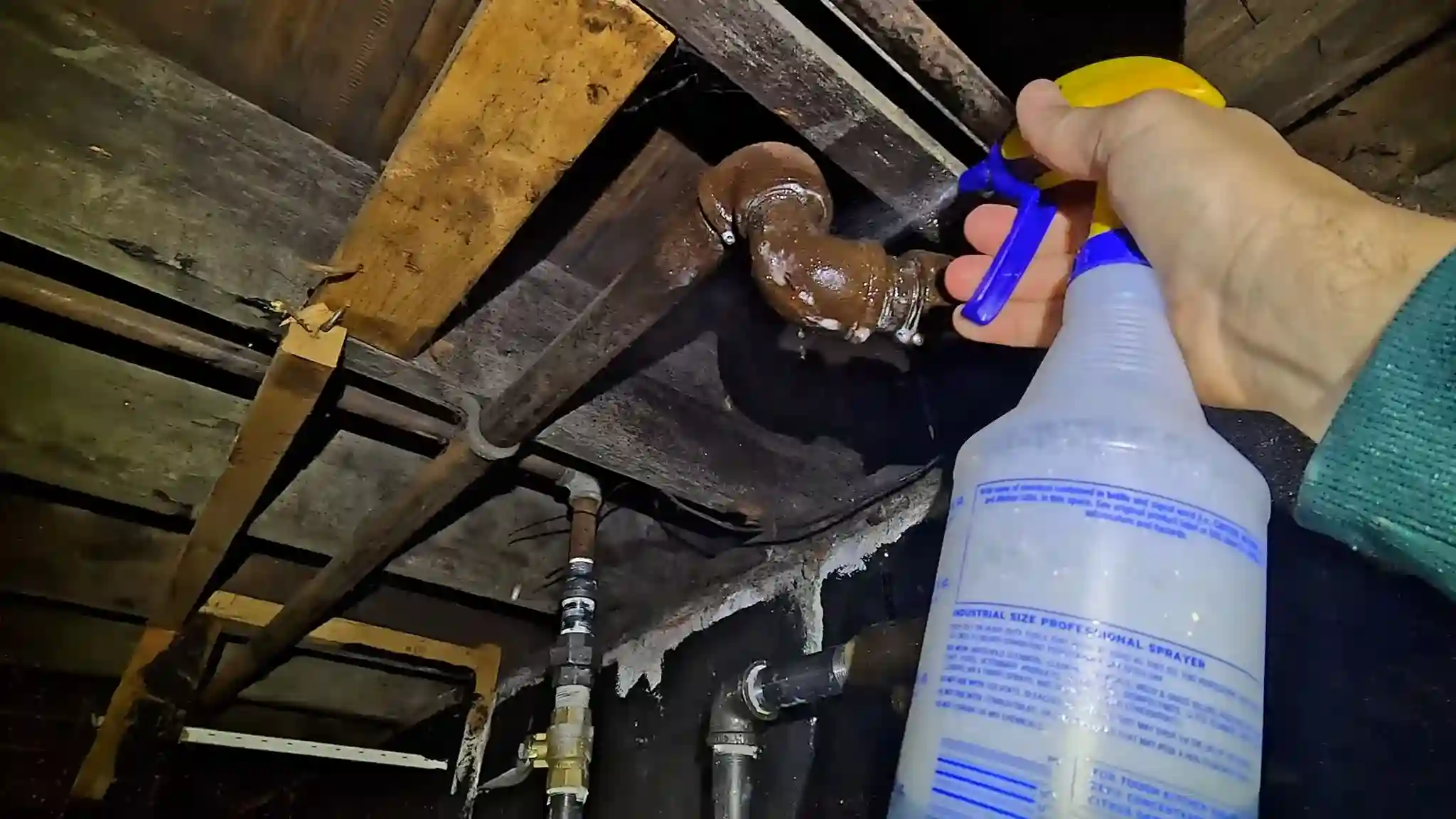 The whole system, proven at once
Why Is Gas Line Pressure Testing in Chicago Its Own Visit?
Because soap and sniffers only reach what you can reach. Soapy water finds the leak on the fitting in front of you — today, at that spot. The gas line pressure testing Chicago buildings actually need answers a bigger question: does the entire system hold — the runs inside balloon-frame walls, the joints above plaster ceilings, the branch nobody has looked at since the Eisenhower administration? One gauge, one number, no blind spots.
- ✓It finds what soap can’t. Leaks too small to bubble, too slow to smell, and too deep in the structure to see — a falling needle reports all of them at once.
- ✓It catches the loose union by hand first. Half our finds start in the visual walk — a fitting that wobbles under a hand today is a leak by February. It gets tightened before the gauge ever goes on.
- ✓It exposes dead legs. Old Chicago systems are full of abandoned runs that go nowhere and cap off behind walls — defunct piping that’s pure liability. Tests find it; we remove or properly terminate it.
What Happens When Pressure Testing Gets Skipped?
An untested repair is an opinion. An untested system after a renovation is a hope. Chicago’s recent history shows exactly what opinions and hopes cost — because every gas disaster in this market shares the same first chapter: a system nobody proved.
💥 The explosion outcome
A Calumet City home was leveled — and more than ten neighboring structures damaged — when an unaddressed leak in an enclosed space found ignition. Crestwood and Woodstock saw the same anatomy. A held pressure test is specifically the instrument that catches “unaddressed” before it becomes “ignited.”
🔥 The fire & poisoning toll
NFPA analyses tie thousands of home structure fires and $100M+ in damage to natural-gas ignition yearly; CDC counts hundreds of CO deaths and tens of thousands of ER visits, stacked into the September–April heating months. Untested systems don’t announce which statistic they’re joining.
💸 The financial slow bleed
The quieter outcomes: a Grade 3 leak inflating every bill for years, an insurance claim contested over unpermitted untested work, a closing delayed because nobody can prove the gas system’s condition, and Chicago’s $4.5M+ annual taxpayer tab for emergency leak responses (PSE Healthy Energy, 2024). A $75–$150 test undercuts every line of that list.
Gas Line Pressure Testing Services Chicago Relies On
The full menu of gas line pressure testing services Chicago properties call for — each one ending the same way: a gauge that held, an affidavit that’s signed, and paperwork the next party in line accepts the first time.
Restoration & Red Tag Tests
The test Peoples Gas needs to see before the restore visit — run, documented, and submitted same-day, because every day off gas is a day too many.
Permit & Inspection Tests
Code-compliant tests with signed affidavits for permitted work — pressure, hold time, and gauge accuracy the inspector expects, photographed for the record.
Real Estate & Closing Tests
Pre-sale and buyer’s-inspection testing scheduled around your closing date — clean paper that moves deals on facts.
Multi-Unit, Per-Meter Testing
Two-flats and three-flats tested the only correct way: every line traced, labeled, and tested per meter — so the utility restores every unit, not just the one that got called in.
Extended 12–24 Hour Tests
Long-hold testing where scope or circumstance demands it — the patient version of proof, monitored and documented start to finish.
Renovation & Pre-Drywall Tests
The cheapest certainty you’ll ever buy: proving disturbed piping before the walls close — because everything costs triple after drywall.
Suspicion & Bill-Creep Tests
No requirement, just a question that won’t quit. A standard test answers it for $75–$150 — usually cheaper than the gas a slow leak wastes by spring.
Annual Pre-Winter Certification
For pre-1960 homes: one early-fall test with a written record, before the heating season stresses every joint in the building.
How Do You Pressure Test a Chicago Three-Flat?
Carefully, and per meter — because a three-flat isn’t one gas system, it’s three systems sharing a basement. The utility restores service account by account, so a test that only proves one line gets exactly one unit turned back on. Our multi-unit protocol comes straight from the jobs that taught it: trace every line from its meter, mark it — first floor, second, third — cap every open branch, then test and document each system separately. When the utility tech arrives, every pipe is labeled, every account has its passing record, and three units come back on with one visit instead of three.
- ✓Traced and labeled before touched — the gas company can’t reconnect what nobody can identify, and half of these basements are unlabeled spaghetti.
- ✓Every open stub found and capped — one forgotten half-union anywhere in the building and the test never holds. Finding them all is the actual skill.
- ✓One restore call, not three — we tell landlords to have all accounts called in together; we hand over passing records for all of them at once.
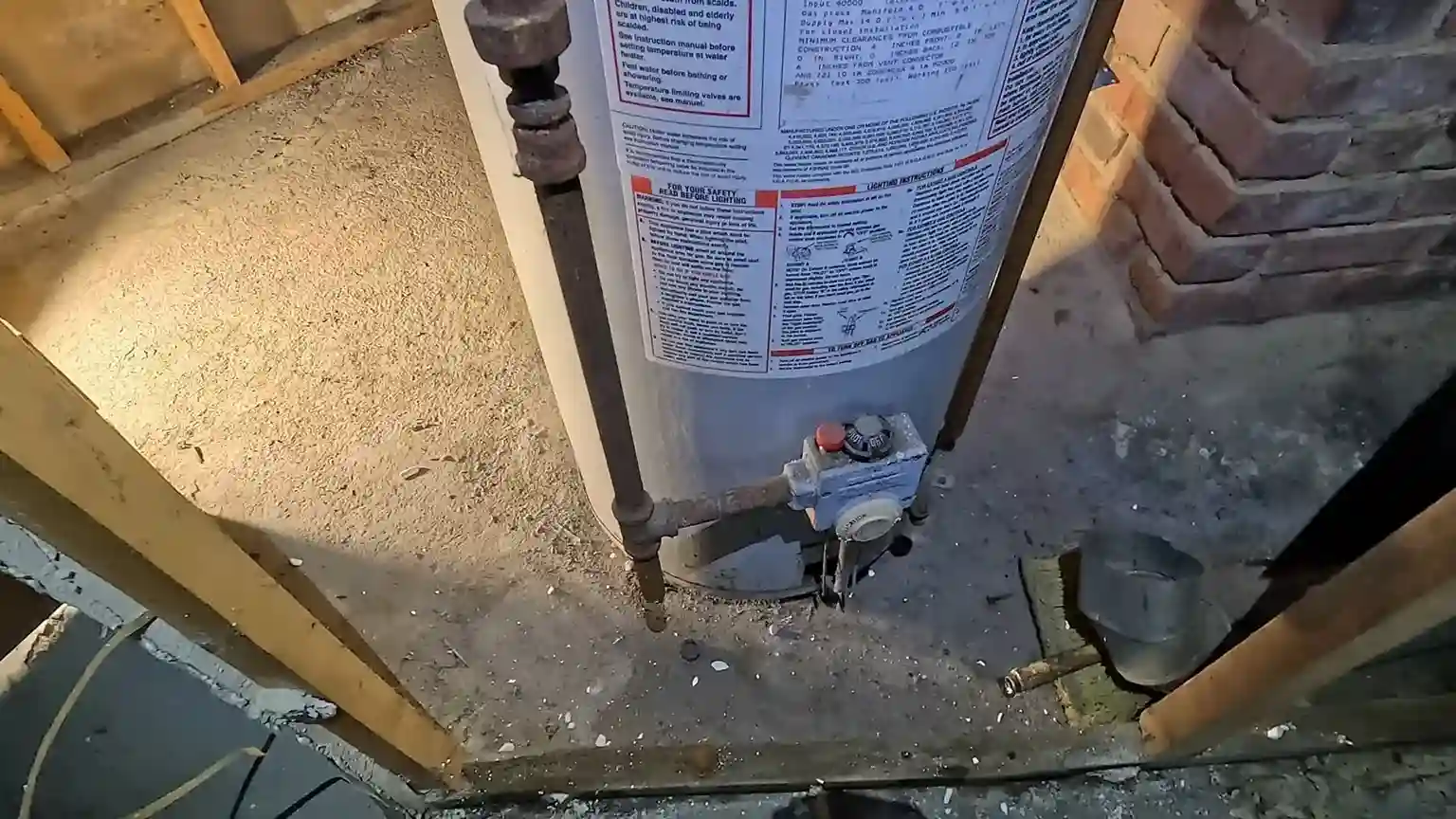 Three meters, three tests, one visit
How Our Chicago Gas Line Pressure Testing Works
The same sequence every visit — and the instrument in the photo is the whole point: a calibrated gauge, locked at test pressure, watched for the full window. Everything else exists to make sure that needle is telling the truth.
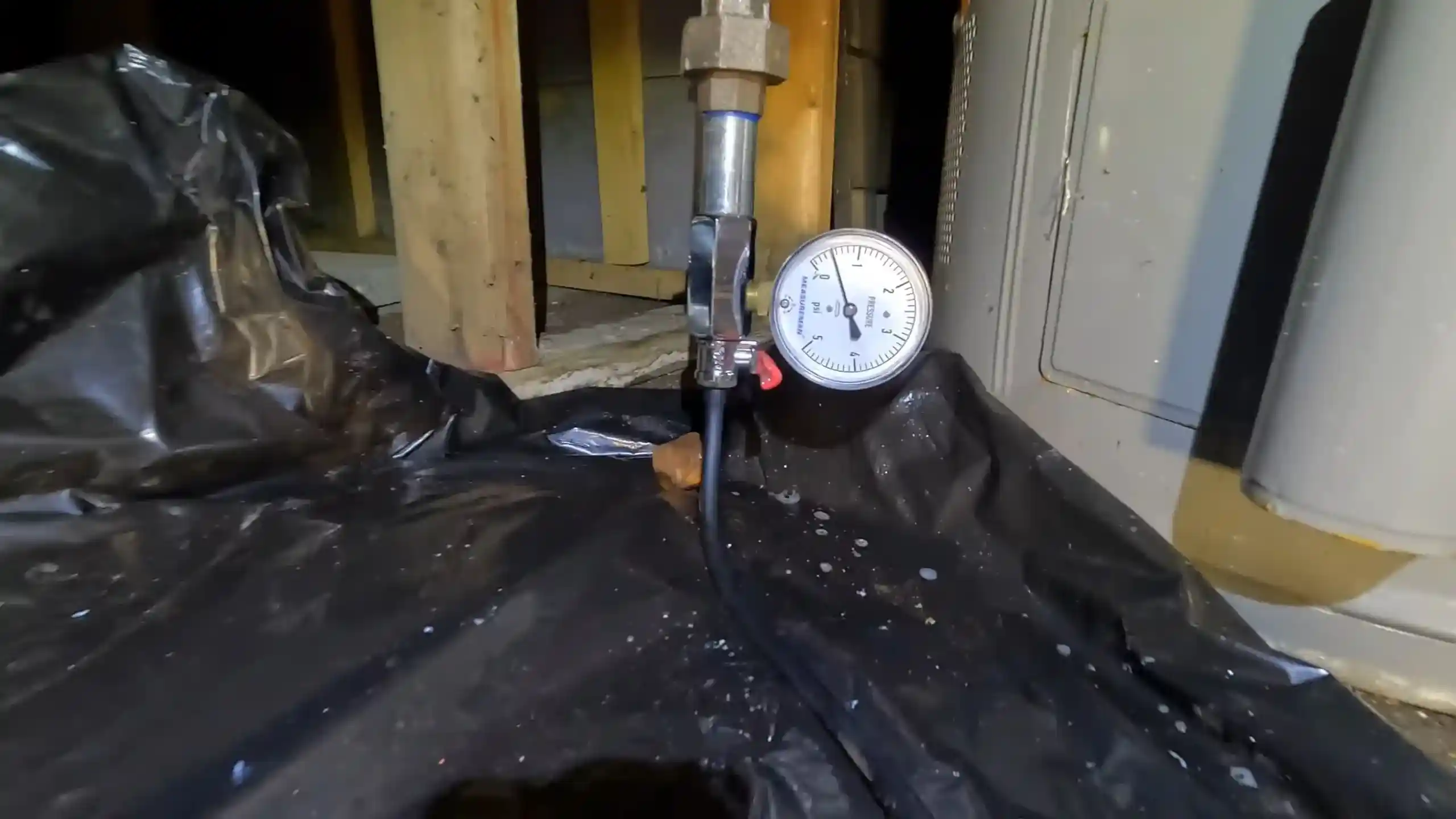 Locked in, holding — the only opinion that counts
Walk it and hand-check it
Before any gauge: eyes and hands on every accessible fitting. A union that wobbles is a leak on layaway — it gets tightened now, because fittings loosen years before they fail.
Isolate and cap everything
Appliances valved off, every open branch and half-union found and plugged. This is where amateur tests die — one uncapped stub in a far corner and the system can never hold.
Pressurize with air or nitrogen
Never live gas. The system comes up to test pressure — many times its quarter-psi working life — and the gauge gets locked in.
Hold the full window & read the needle
A crash in seconds means a major leak: we fix it first, then run the real test. A slow drift means small leaks to isolate. Dead steady for the full hold means pass — and you’re welcome to stand there watching with us.
Soap the joints anyway
Even on a pass, suspect joints get the spray-bottle confirmation. The gauge proves the system; the bubbles prove each fitting. Belt, meet suspenders.
Affidavit, photos, hand-off
Signed test affidavit, gauge photos, readings, and anything the inspector, utility restore desk, or closing attorney needs — delivered before we leave, not “emailed later.”
What Is the Needle Actually Telling Us?
Anyone can pump air into a pipe. Reading what happens next is the trade. Here’s the honest decoder — the same one running in our heads at every test.
| What the gauge does | What it means | What happens next |
|---|---|---|
| Holds dead steady, full window | The system is tight — every joint, every hidden run | Pass. Affidavit signed, photos taken, paperwork moves. |
| Crashes within seconds | A major leak — big enough that the test can’t even start honestly | Triage: find and fix the big one first (they’re rarely subtle), then run the real test on the whole system. |
| Slow, steady drift downward | One or more small leaks — the kind soap and noses miss for years | Branch isolation narrows which section can’t hold; then pinpoint and repair. This is the test doing exactly its job. |
| Holds — but only in mild weather | Temperature-dependent fitting: sealed at 40°F, weeping at 10°F | An intermittent — we test under the conditions that make it talk. More on our detection page. |
| Passes, but the odor complaint continues | The gas system is fine — something else isn’t | Check CO, sewer gas, and the utility side of the meter. A pass narrows the mystery; it doesn’t dismiss you. |
Where Do Chicago Systems Fail the Test?
Four decades of the same housing stock means the same failure points, visit after visit. These are the places the needle points to most — and where we look first when it drifts.
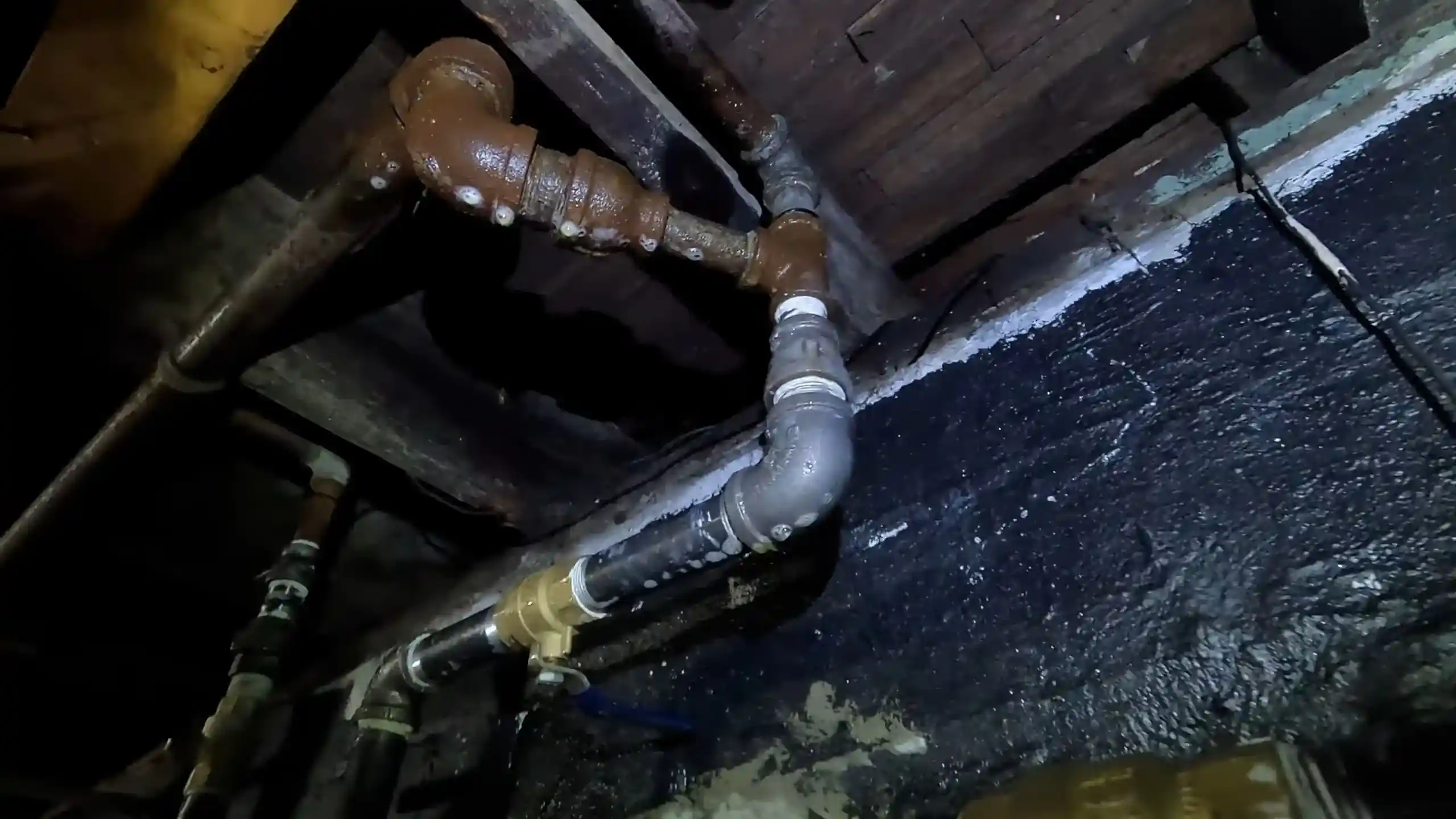
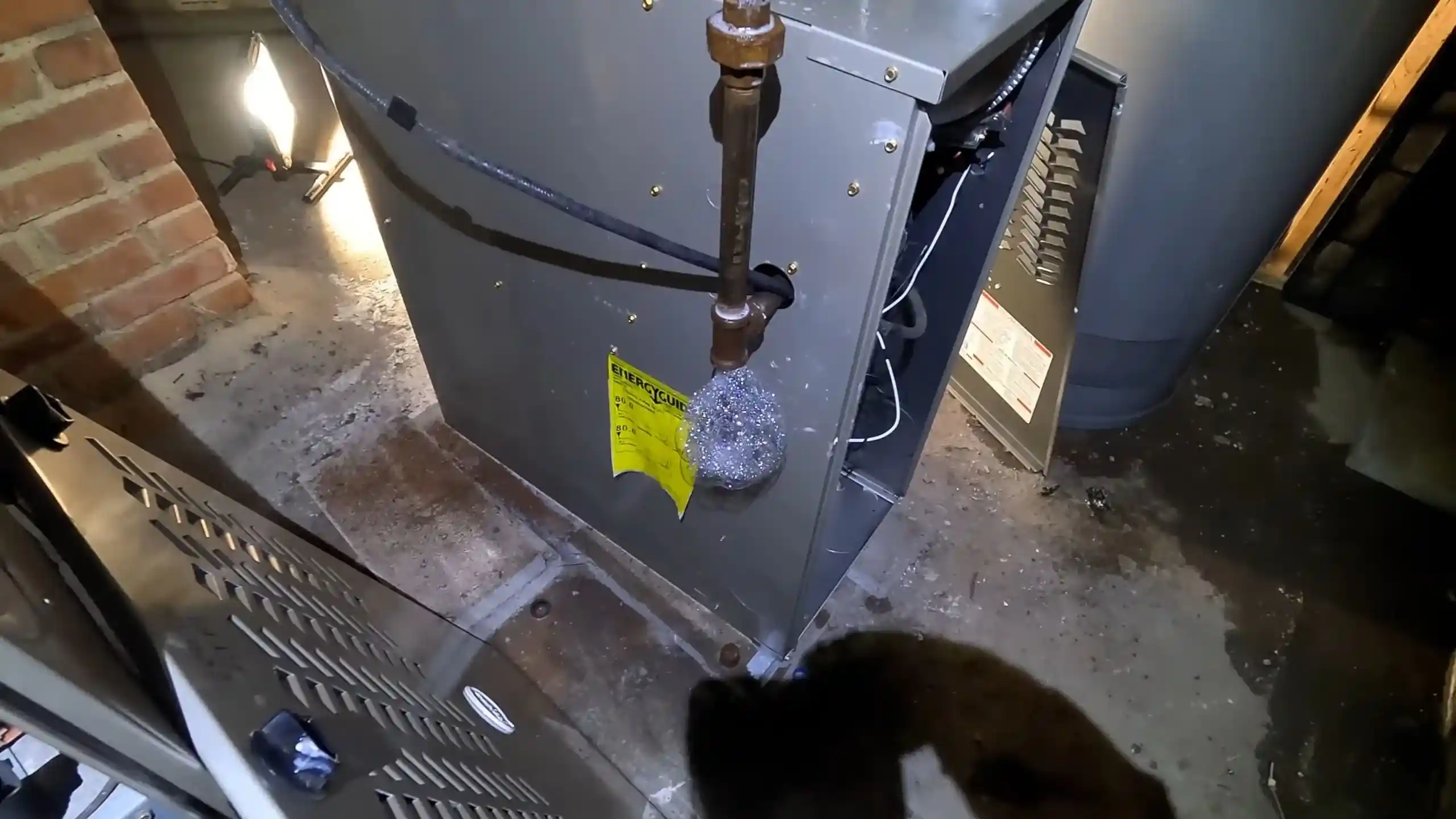 Water heater valves — seized stems, tired packing
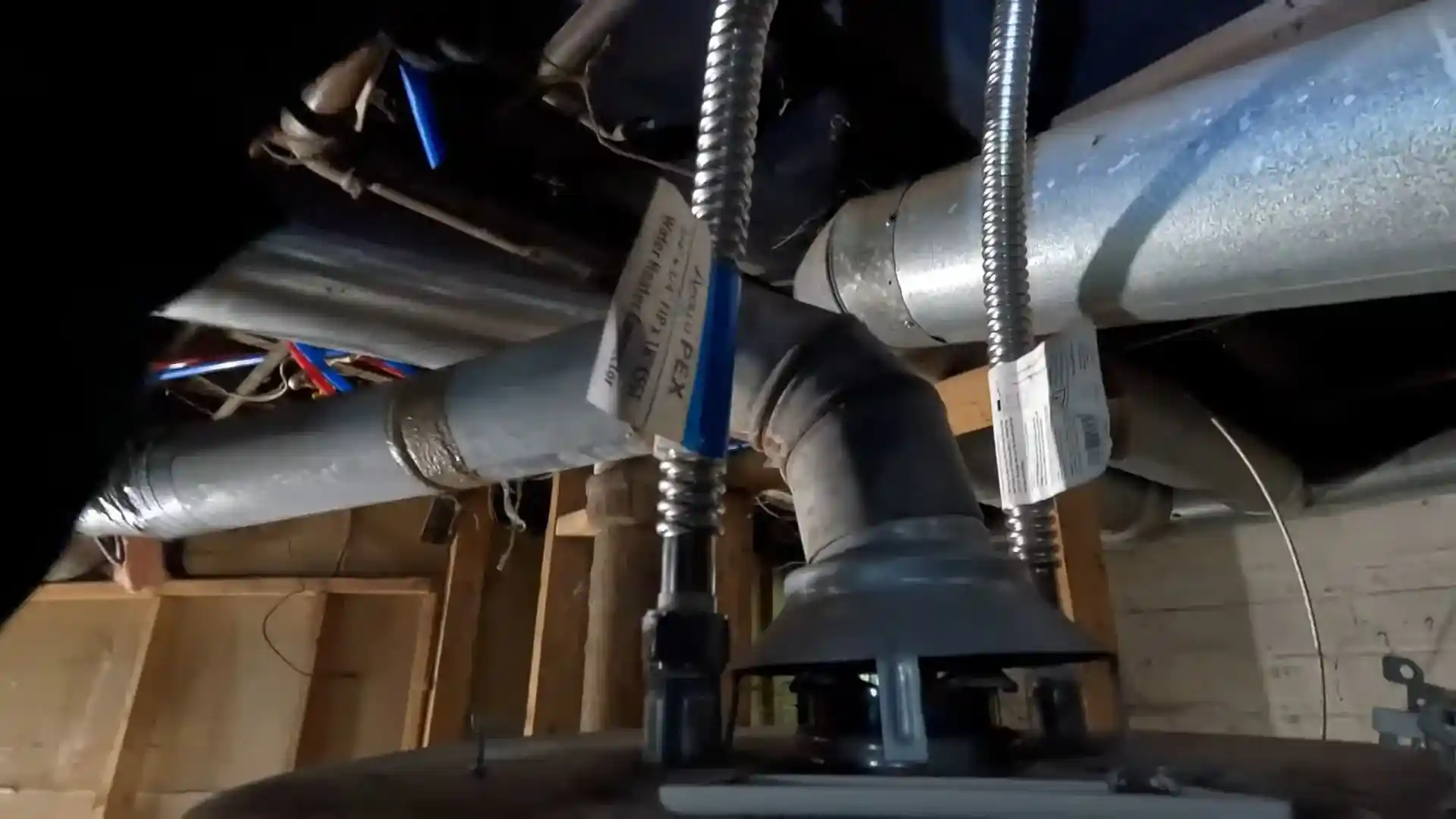 Heater connections — corroded nipples & unions
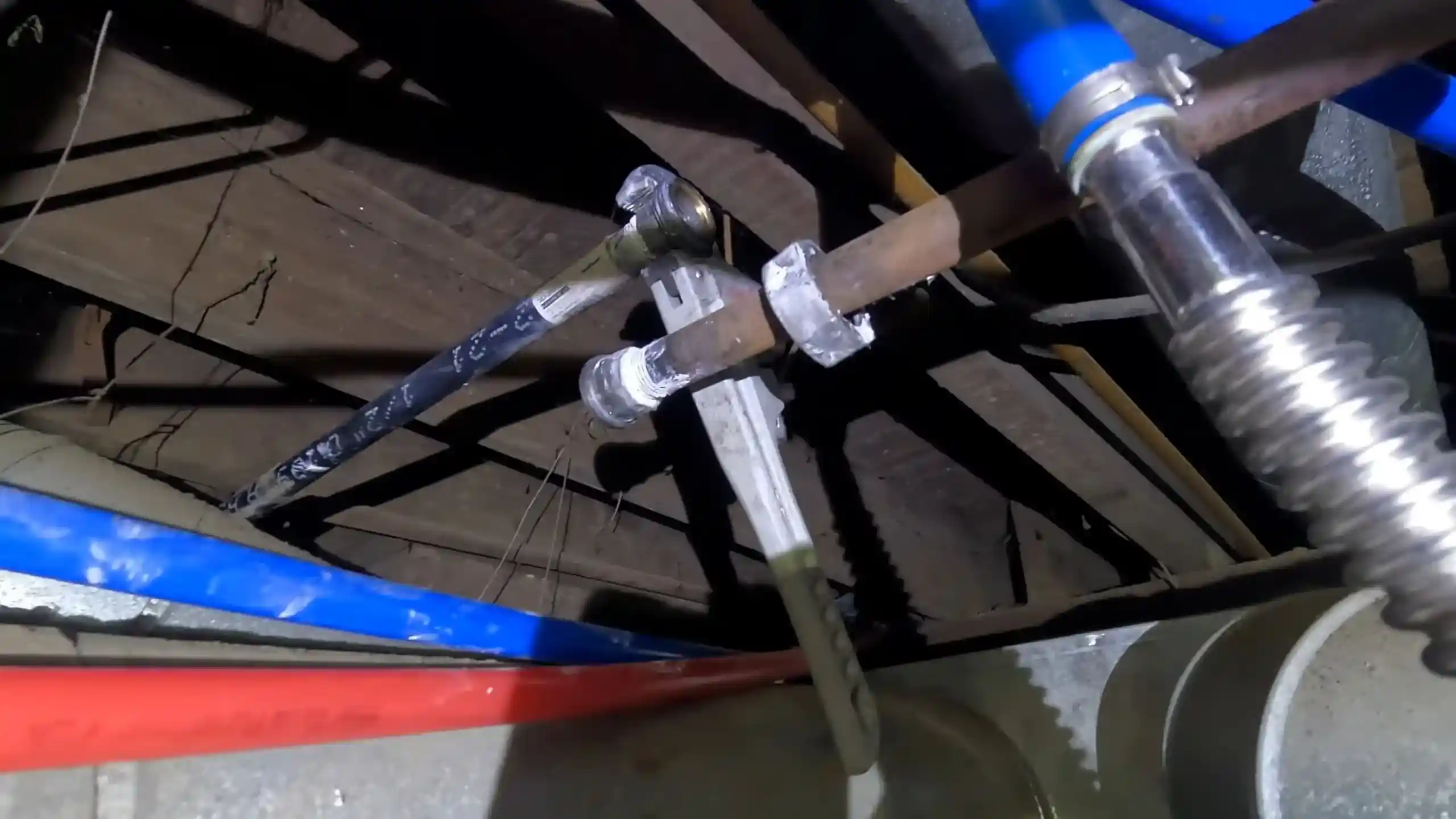
 Overhead fittings — strain from failed hangers
 Wrapped fittings — corrosion hiding under insulation
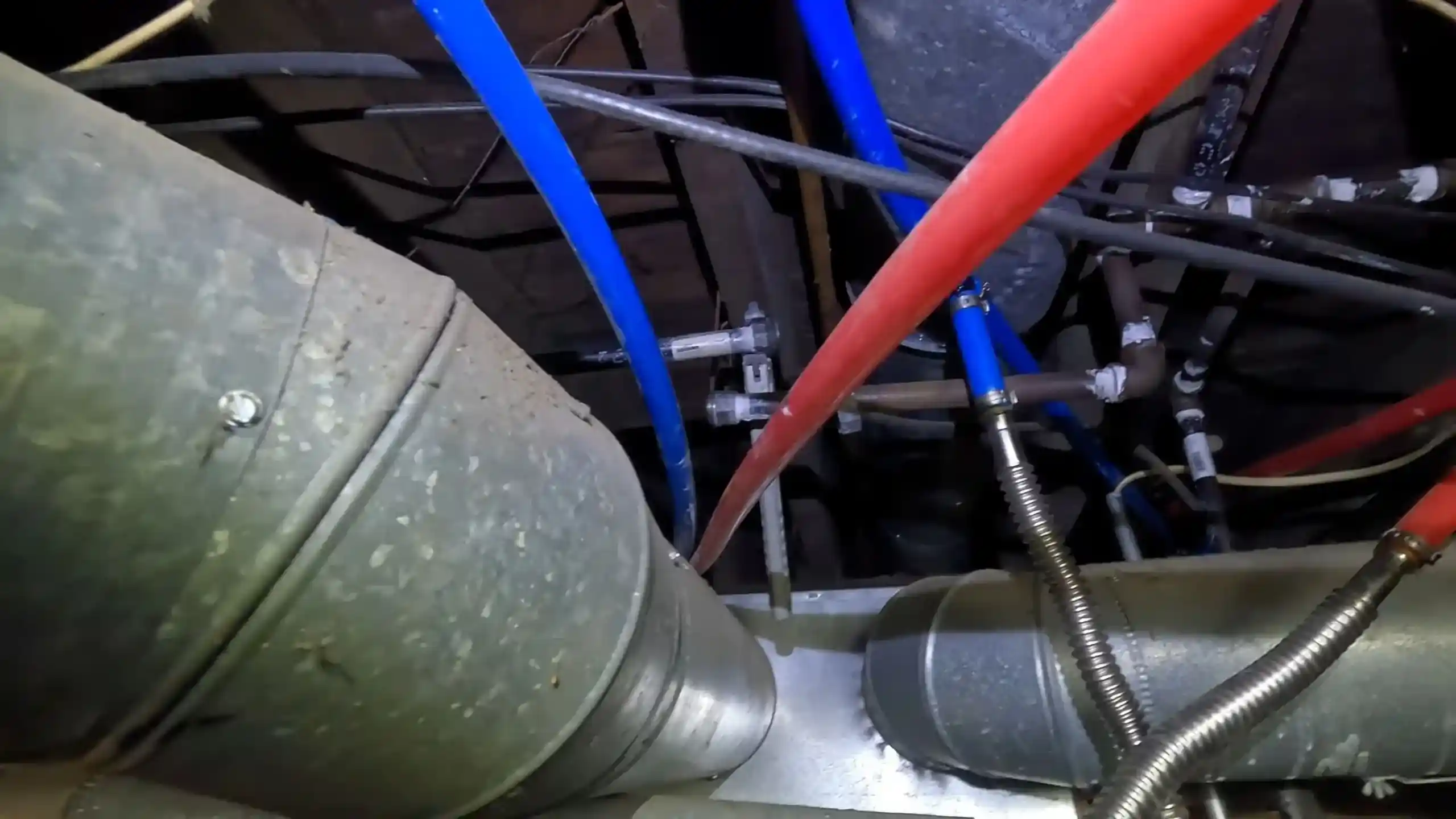 Crawlspaces — where pipe goes decades unseen
The places nobody’s looked since the pipe went in
Crawlspaces, pipe chases, above drop ceilings, behind water heaters shoved into corners — Chicago basements hide gas runs in places no flashlight has visited in decades. This is precisely why the gauge outranks every visual method: it doesn’t need to see the pipe to prove it. When the needle drifts, then we go crawling — with a reason, a reading, and a much shorter list of places to look.
- ✓Old handyman work surfaces here — wrong sealant, unsupported runs, and mystery tees from renovations past. The test finds their legacy.
- ✓Adjacent hazards get flagged too — while we’re in there: missing flue caps, back-drafting signs, appliances in shape “dangerous to operate.” You hear about all of it, in writing.
Gas Line Pressure Testing Chicago Cost: Flat and Fair
Testing is the most predictable service we offer, so the pricing should be too. Here it is — including the tier some competitors’ price lists start $75 above.
| Test type | Typical Chicago range |
|---|---|
| Standard pressure test (single residential system) | $75 – $150 |
| Multi-line testing (two- & three-flats) | $75–$150 per line |
| Extended hold test (12–24 hr where required) | up to $500 |
| Multi-unit / per-meter testing (two- & three-flats) | Quoted per meter — before we start, with the labeling included |
| Test bundled with our repair or install work | Included — never a separate line item on our own work |
| After-hours / emergency restoration testing | Standard rate × 1.5–2, disclosed on the phone |
Pressure Testing Case Studies From Chicago Buildings
Representative cases from the tests this housing stock orders on repeat — every Chicago gas line pressure testing job below follows the same arc: situation, setup, reading, outcome.
Three meters, one restore visit
SituationUtility shutoff on a three-flat; landlord facing three cold units and a basement of unlabeled pipe.
SetupEvery line traced from its meter and marked — first, second, third floor — open stubs capped, one loose union caught by hand.
ReadingTwo lines crashed the gauge in seconds: two major leaks fixed first. All three systems then held their full windows.
OutcomeThree passing records, all accounts called in together, one utility visit, whole building back on.
The closing that needed paper
SituationBuyer’s inspector requested a gas pressure test on a pre-war unit; attorneys wanted documentation, not reassurance.
SetupUnit line isolated from the stack, appliances capped, calibrated gauge locked at test pressure.
ReadingDead steady, full window — photographed with a timestamp.
OutcomeSigned affidavit to both attorneys same day; closing held its date.
Tested before the drywall lied
SituationKitchen-and-bath gut nearly finished; piping had been moved twice by two different crews. Owner wanted proof before closing walls.
SetupWhole-system test with the renovated branches under specific watch.
ReadingSlow drift — isolation traced it to a renovation-era fitting sealed with the wrong compound.
OutcomeRebuilt properly, retested to a dead-steady hold, walls closed on a proven system.
The dead leg nobody remembered
SituationFaint intermittent odor, two clean visual inspections by others, homeowner told “it’s probably nothing.”
SetupFull-system pressure test — the method that doesn’t care whether pipe is visible.
ReadingSlow drop; isolation pointed at a branch that served… nothing. An abandoned run from a long-gone space heater, weeping at a blind cap behind plaster.
OutcomeDead leg removed at the tee, system simplified, retest held. “Probably nothing” had been leaking for years.
How to Vet Any Testing Company — Including Us
The gas line pressure testing Chicago can trust is only as honest as the person running it — and the six questions below expose the difference in one phone call. Our review pages go live with the business, every review from a real Chicago address. Meanwhile, run this on anyone:
1. “What pressure, held how long?”
The answer should arrive instantly with real numbers — test pressure, hold time, zero-drop standard. Vagueness here is vagueness everywhere.
2. “Air or nitrogen — never live gas?”
Non-negotiable. Testing on natural gas isn’t a shortcut; it’s a hazard with an invoice.
3. “Can I watch the gauge?”
Yes should be immediate — we’d rather you watch. A test you witnessed is a test you never have to take on faith.
4. “Do I get a signed affidavit?”
With photos and readings. If the proof lives only in a verbal “you’re good,” you paid for a shrug.
5. “Multi-unit: per meter, labeled?”
Every line traced and marked, every account documented. “We’ll just test the main” is how two of your three units stay cold.
6. “What happens if it fails?”
The honest answer: findings, then a quote, then your decision. A failed needle that instantly becomes a high-pressure sales pitch tells you who the gauge really works for.
Your Real Options for Proving a Gas System
Every method below has a legitimate job. Only one of them proves the whole system — including the parts nobody can see.
| What matters | GasGuard pressure test | DIY soapy water | Utility leak check | “Sniff test” & hope |
|---|---|---|---|---|
| Proves hidden piping in walls & chases | ✓ That’s the whole point | ✗ Only what you can reach | ✗ Hazard survey, not certification | ✗ |
| Finds leaks below smell threshold | ✓ The needle doesn’t adapt | ~ Only large, accessible ones | ~ Instruments, but grading only | ✗ Odor fatigue is real |
| Produces documentation others accept | ✓ Signed affidavit + photos | ✗ | ✗ | ✗ |
| Satisfies utility restoration / permits | ✓ Built for exactly that | ✗ | — They’re the ones requiring it | ✗ |
| Cost | ~ $75–$150 standard | ✓ A spray bottle | ✓ Free — call them first for odors | ✓ Free, worth exactly that |
Honest note: soapy water is genuinely useful — on the grill connector you can see and reach. Its limit is the reason this page exists: soap finds the leaks in front of you; only pressure finds the ones that aren’t.
Gas Line Pressure Testing in Chicago: Questions, Answered
How much does a gas pressure test cost in Chicago?
$75–$150 for a standard single-system test, $75–$150 for a full-home test with written report and affidavit, up to $500 for extended 12–24 hour holds, and per-meter quotes for multi-unit buildings. Tests bundled with our own repair or install work are included free — and after-hours rates (1.5–2x) get disclosed on the phone, never discovered on the invoice.
What pressure is a gas line tested at, and for how long?
Residential tests in this market typically run at 3 psi or 1.5× operating pressure — whichever is greater — held a minimum of 15 minutes with zero drop on a calibrated gauge. For perspective, your system operates at roughly a quarter of one psi, so the test proves a wide safety margin, not just bare function. Larger scopes and some utility situations call for longer holds.
Is a pressure test required to get my gas turned back on?
After a shutoff or red tag, effectively yes — the utility wants proof your side of the meter holds before the restore visit, and a documented passing test is that proof. It’s also standard after permitted repairs, new lines, and meter changes. Our restoration tests run same-day because we know exactly what the restore desk wants to see.
Can I just use soapy water instead of a real test?
On a visible fitting you can reach — sure, as a first look. But the gas pressure testing Chicago inspectors and utilities require exists because soap has hard limits: it only finds leaks big enough to bubble, at joints you can see, on the day you spray. A pressure test interrogates the entire system at once, including every hidden run. Use both; trust the gauge.
What happens if my system fails the test?
You get findings, not pressure. A fast crash means one big leak — usually quick to find and fix. A slow drift means small leaks we narrow down by isolating branches. Either way: locate, quote at published repair tiers, fix on your go-ahead, retest until the needle holds, update the paperwork. Most failures are fixed and retested the same day.
Do appliances stay connected during the test?
No — appliances are valved off and the piping is isolated, because appliance valves and regulators aren’t rated for test pressure. That’s also why every open branch must be capped first: the test proves the piping, and one forgotten stub anywhere means the gauge can never hold.
How long does the whole visit take?
Most single-family tests run 30 minutes to two hours door to door — setup and capping take longer than the hold itself. Multi-unit buildings take longer because each meter’s system gets traced, labeled, and tested separately. Extended-hold tests are their own scheduled animal.
Do you test with natural gas?
Never — compressed air or nitrogen only. Pressurizing a system with live gas to hunt for leaks is exactly the hazard the test exists to prevent. It’s also how you tell a real testing outfit from an improviser in one question.
My building has three meters. Does one test cover everyone?
No — and this catches landlords constantly. Each meter feeds its own system, and the utility restores per account. We trace and label every line, test each system, and document each pass, so all units come back with one utility visit. Pro tip from the field: have all accounts called in together.
If my system passes, does that mean no CO risk?
No — different hazard, different test. The pressure test proves your piping doesn’t leak gas; carbon monoxide comes from combustion problems in appliances, flues, and vents. We check CO alongside testing whenever furnaces or water heaters are involved, and we flag anything we see — a missing flue cap or a back-drafting heater goes in your report even though it’s not what you called us for.
How often should an older Chicago home be tested?
Pre-1960 buildings: once a year, ideally early fall before the furnace stresses every fitting — and always after renovations, appliance swaps, or any work that touched piping. A century-old system that’s never seen a gauge isn’t “proven by time”; it’s just never been asked the question.
What’s a “dead leg” and why does it matter?
Abandoned piping that still connects to your live system but serves nothing — the line to a space heater removed in 1987, capped somewhere behind plaster. They’re common in old Chicago homes, invisible to visual inspection, and a standing liability. Pressure tests expose them, and we remove or properly terminate every one we find.
Do you provide the affidavit and paperwork for permits and closings?
Every test: the signed pressure-test affidavit, timestamped gauge photos, readings, and whatever supporting notes your inspector, attorney, or the utility restore desk expects — handed over before we leave. Paperwork is the product; the gauge is just how we earn it.
Pressure testing Across Chicago’s Neighborhoods
Every job on this page runs the same across the city — and these neighborhoods have dedicated pages covering exactly how their housing stock behaves: Lakeview, Lincoln Park, Portage Park, Bridgeport, McKinley Park, Beverly, Morgan Park, Hyde Park, Logan Square, Avondale, Rogers Park, Edgewater, Jefferson Park, North Center, Albany Park, and Wicker Park. Anywhere else in Chicago: same published pricing, same-day response — one call covers the whole city.
Stop Hoping. Start Holding.
A shutoff to reverse, a closing to protect, a renovation to prove, or a question that won’t quit — every test ends the same way: a needle that held, an affidavit that’s signed, and one less thing your house is keeping from you.
☎ Call (773) 200-2148 — Same-Day Tests Licensed & insured in Illinois • Chicago-only service • Affidavit, photos & readings included with every test