
Gas Line Installation Chicago, IL — Sized Right, Run Once.
The gas line installation Chicago, IL homes actually need starts before any pipe: a load calculation that sizes the line to the appliance, a permit filed before the first thread is cut, and a pressure test that proves the new run before anything lights. New range, tankless, grill, garage heater, or generator — run once, run right.
🔧 New line — or fixing an old one?
This page is for new gas lines. Two quick reroutes if that’s not you.
- Adding an appliance, grill, heater, or generator? You’re in the right place — keep reading, the sizing table below will save you a change order.
- Existing line leaking or red-tagged? That’s our gas line repair team — same-day response, documentation included.
- Smell gas but don’t know the source? Start with gas leak detection — pinpoint first, then decide.
Gas Line Installation in Chicago, IL
A pro-style range that needs more fuel than a 1950s half-inch branch can feed. A garage heater at the end of a Beverly deep lot. A standby generator after the last polar vortex made the case. A deconversion putting a kitchen where a bedroom used to be. Gas line installation in Chicago, IL is how this city’s housing keeps adapting — and between load math the old piping was never sized for, trenching through fill soil and frost depth, and a permit office with real opinions, it’s work that rewards specialists. Sized by calculation, run in the right material, permitted every time (~$75), and pressure-tested before the first burner lights.
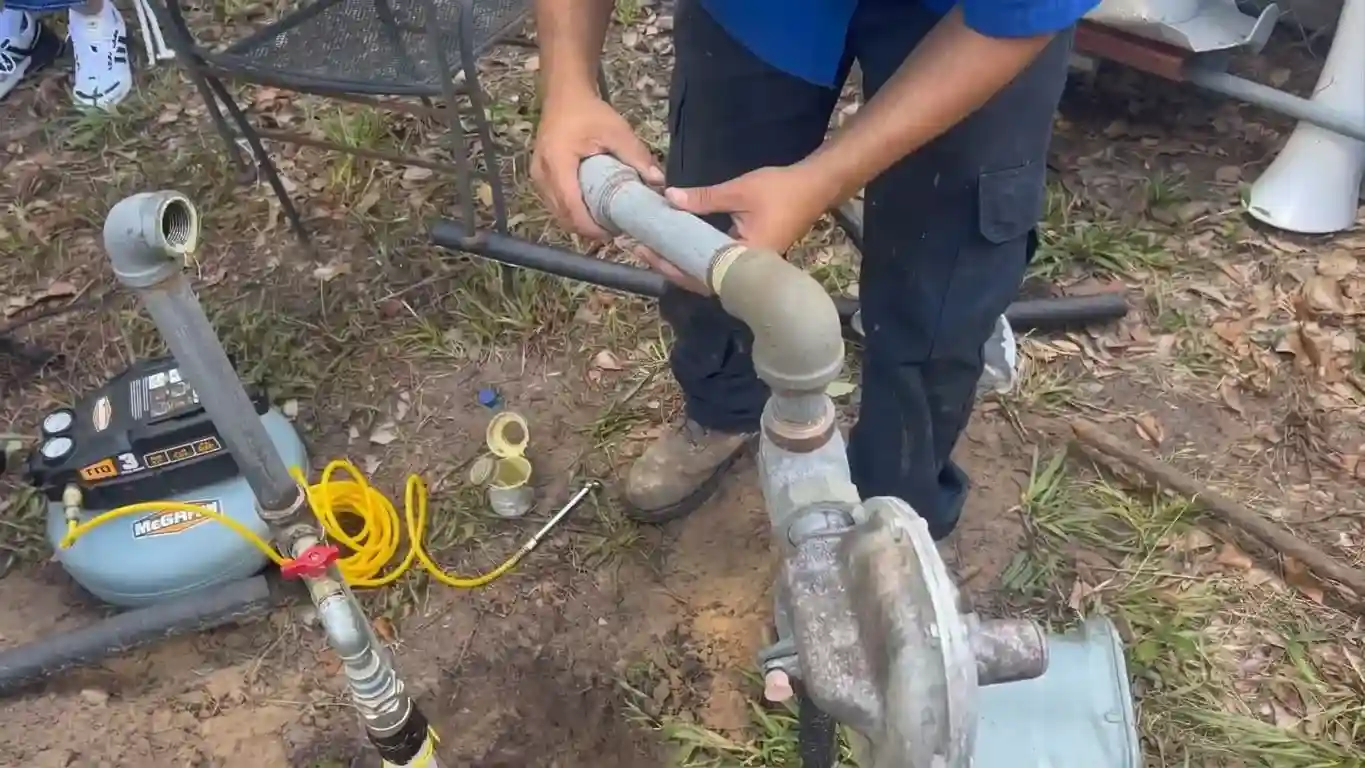 New line, threaded and tested — Chicago, IL
Why New Gas Lines in Chicago Aren’t Plug-and-Play
Gas line installation in Chicago means threading new pipe into buildings that predate the appliances being connected — a 199,000-BTU tankless water heater feeding off piping sized in 1954, a standby generator asking a residential meter for more than it was ever built to deliver. The gas line installation Chicago homes get from us starts with the math: total connected load, longest-run length, pipe size from the code tables. Skip that step and the appliance starves — yellow flames, error codes, and a “new” line that was wrong the day it was installed.
- ✓Sized from a load calculation, not a habit. The most common install defect we correct is pipe that’s simply too small for what’s connected to it.
- ✓Threaded on site to fit your run — power threader on the truck, assemblies pre-built on the pipe vice, gas-rated compound good for fifty years.
- ✓Permit filed before pipe is cut. Paper first is cheaper than paper later — unpermitted gas work surfaces at exactly two moments: your insurance claim and your closing.
Gas Line Installation Services Chicago Homes Book
The full range of gas line installation services Chicago properties call for — every one sized to the appliance, permitted with the city, and pressure-tested before the first flame.
Range & Cooktop Lines
Kitchen renovations, electric-to-gas conversions, dual-fuel upgrades — with a code-required shutoff behind the appliance and a connector rated for the job.
Gas Dryer Lines
Laundry moves and first-time gas dryer hookups — a short branch done right beats a long extension cord of bad decisions.
Water Heater & Tankless
The classic upsize: tankless units pull 3–5x the BTUs of the tank they replace. We size the new line for what’s actually being fed — details in the table below.
Furnace & Boiler Supply
New heating equipment, relocated mechanicals, basement build-outs — supply lines with proper drip legs and shutoffs at the unit.
Outdoor Grill & BBQ Lines
A permanent natural-gas grill line ends the propane-tank shuffle forever — regulator matched, shutoff at the patio, buried run done to code.
Fire Pits & Patio Heaters
Backyard fire features and patio heat with a proper key valve and a line sized for the burner — not a hose from the garage.
Garage & Shop Heaters
Detached-garage heat means a buried run: trenched to depth, modern PE pipe with tracer wire, riser transitions at both ends.
Standby Generator Lines
Big BTUs, long runs, and almost always a meter-capacity check with Peoples Gas — the coordination is part of our job, not your homework.
What Size Gas Line Does Your Appliance Need?
Pipe size comes from two numbers: the appliance’s BTU demand and the length of the run feeding it — longer runs need bigger pipe to deliver the same gas. Here are the typical demands we size for. Exact sizing on your job comes from the code tables and your home’s total connected load; this is the honest preview no competitor publishes.
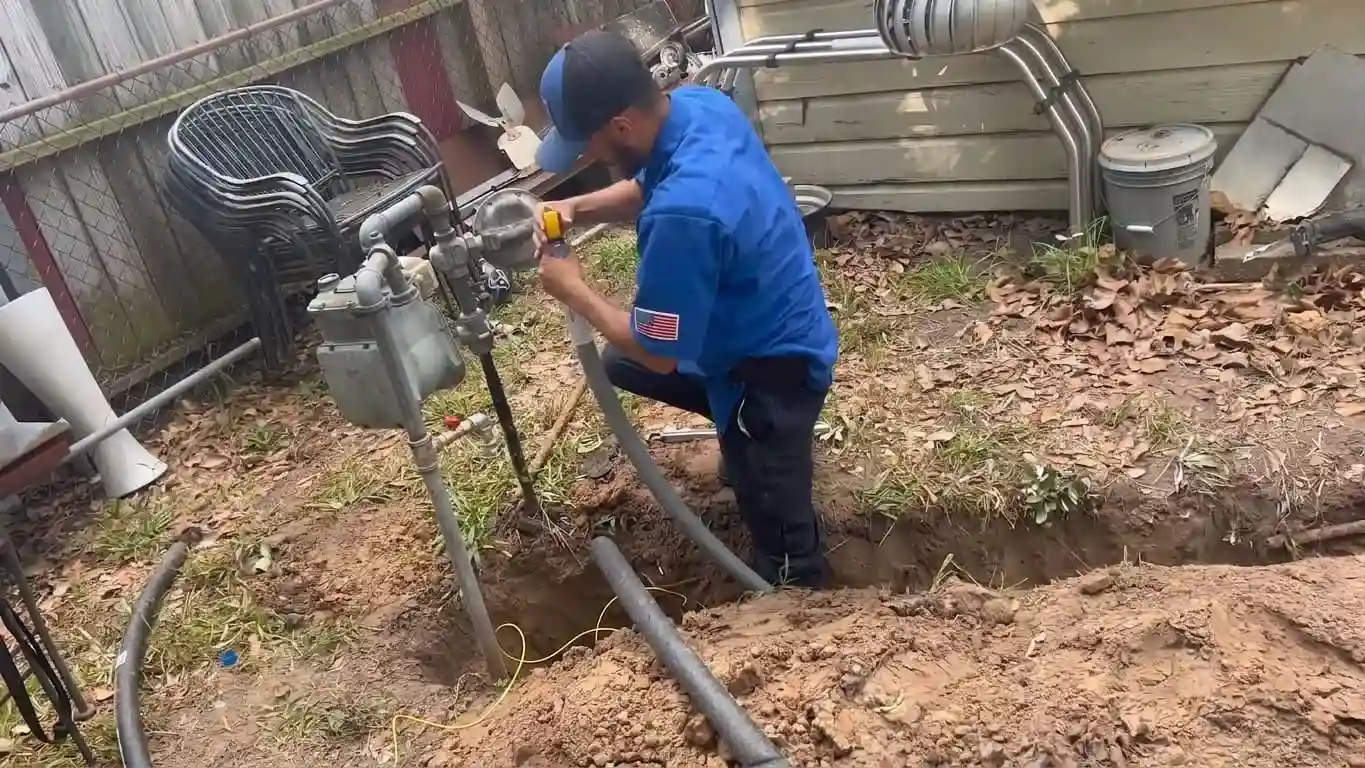 Sized to the load, not the leftover pipe
| Appliance | Typical demand | Typical branch size | Worth knowing |
|---|---|---|---|
| Gas range / cooktop | ~40,000–65,000 BTU | Usually 1/2″ | Pro-style ranges run hotter — check the rating plate, not the assumption |
| Gas dryer | ~22,000–35,000 BTU | 1/2″ | The easiest install on this table — if the run is short |
| Tank water heater | ~40,000 BTU | 1/2″ | The baseline everything else gets compared to |
| Tankless water heater | ~150,000–199,000 BTU | Often 3/4″–1″ | The classic surprise: 3–5x the tank’s demand. The old 1/2″ line will not feed it — upsizing is usually part of the honest quote |
| Furnace / boiler | ~60,000–120,000 BTU | 1/2″–3/4″ | Sized with the rest of the house’s load, never in isolation |
| Built-in grill | ~50,000–100,000+ BTU | 1/2″–3/4″ | Big burners + long backyard run = the most under-sized install we see |
| Garage / shop heater | ~30,000–75,000 BTU | 1/2″–3/4″ | Run length to a detached garage usually decides the size, not the heater |
| Standby generator | ~100,000–200,000+ BTU | 3/4″–1″+ | Almost always triggers a meter-capacity conversation — see below |
Extend the Existing Line, or Run a New One?
Every gas line installation Chicago books starts with this decision, and it’s math, not preference: what’s the spare capacity in your existing piping after everything already connected takes its share? Tap a line that has no headroom and every appliance on it gets a little worse. Here’s how we call it — out loud, with the numbers in front of you.
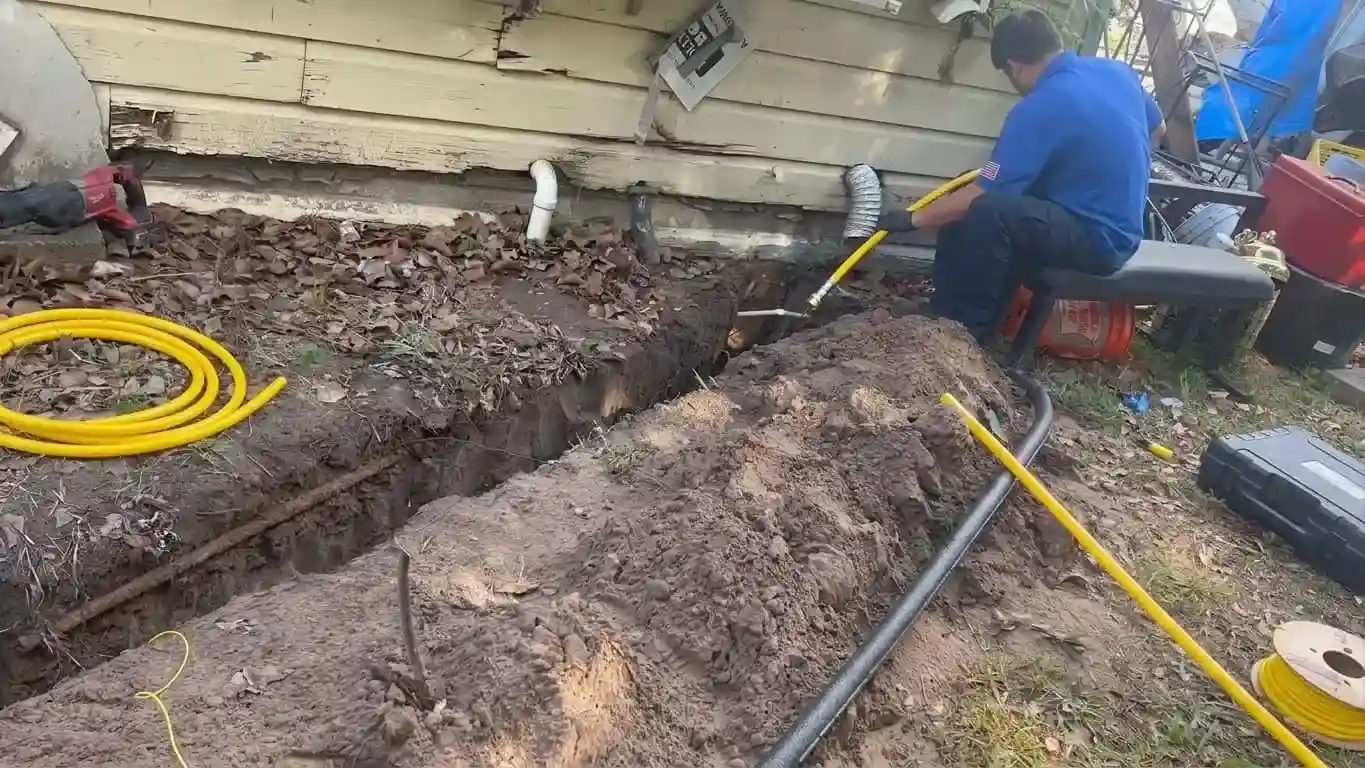 When the answer is “run new” — done properly
| Factor | Points toward tapping existing | Points toward running new |
|---|---|---|
| Spare capacity | Existing line has BTU headroom after current load | Line is already at or near its table limit |
| Appliance demand | Small load — dryer, standard range | Big load — tankless, generator, pro range |
| Distance | New appliance sits near existing piping | Detached garage, back patio, opposite end of the house |
| Existing pipe condition | Sound black iron with clean threads | Corroded runs or galvanized — don’t build on a bad foundation |
| Future plans | This is the last gas appliance you’ll add | More coming — size the new run once for all of it |
Black Iron, CSST, or PE: What New Installs Use
Three legitimate materials, three different jobs — and one thing we never install. Choosing by application, not by what’s on the truck, is half of what “licensed” is supposed to mean.
| Material | Where it belongs on new work | The install detail that matters |
|---|---|---|
| Black iron (threaded steel) | Interior runs — the Chicago standard for exposed basement and mechanical piping | Threaded on site, sealed with gas-rated compound, hung to code so joints carry no strain |
| CSST (yellow flexible) | Snaking through finished walls and tight retrofits where rigid pipe means demolition | Must be electrically bonded — unbonded CSST can arc and perforate in a lightning strike. Bonding is part of our install, not an option |
| PE (yellow plastic, buried) | Every buried run — garage, grill, generator. It doesn’t corrode, ever | Installed with tracer wire so it can be located for the rest of its life, with riser transitions to steel before it surfaces |
| Galvanized steel | Nowhere. Not on our trucks for gas, period | The zinc lining flakes and migrates into appliance valves — it’s a repair page problem we refuse to install new |
How Does Chicago Gas Line Installation Actually Work?
Same sequence every install — and the photo shows the step that separates finished from proven: the new line under test pressure from the compressor, holding, before a single pilot lights. Your system will run at roughly a quarter of one psi; we prove the new run at many times that first.
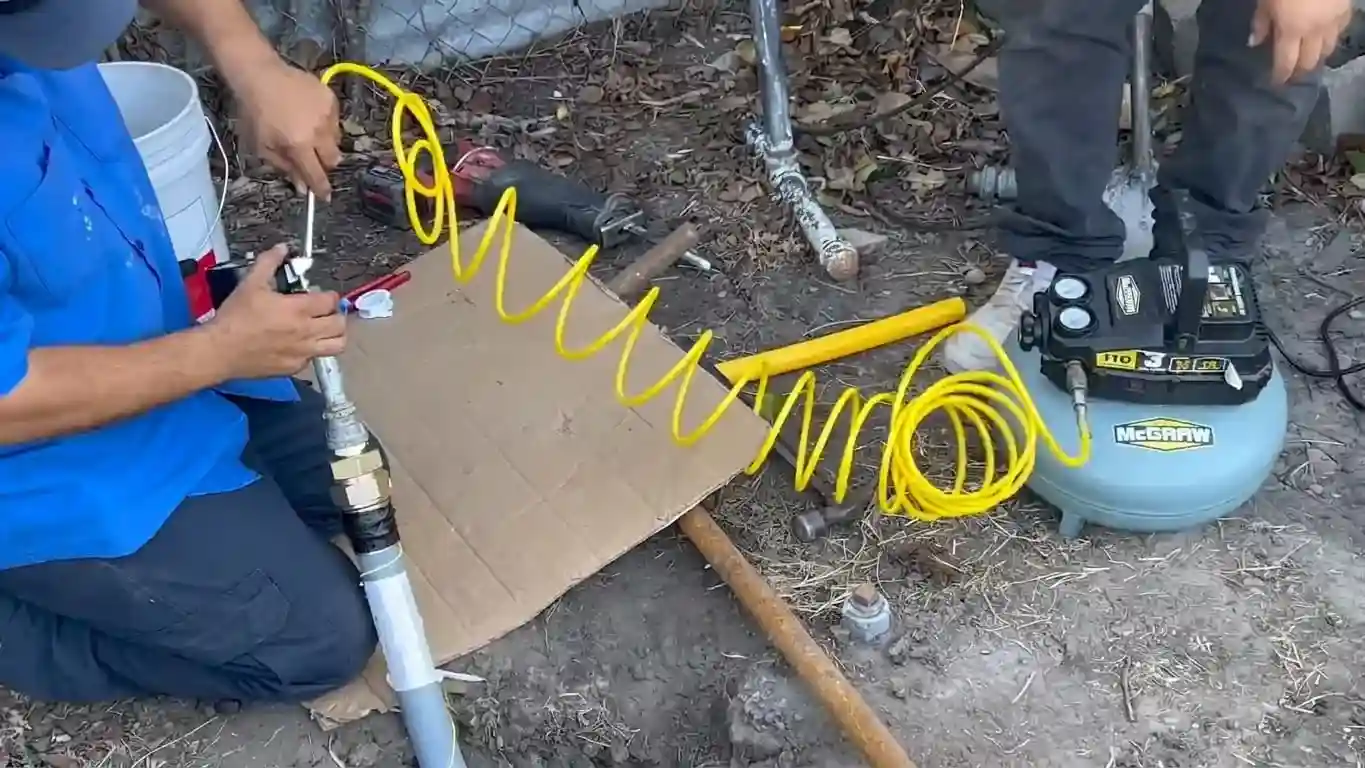 Test pressure on, gauge holding — then we light
Load calculation & route plan
Appliance BTUs, total connected load, longest-run length — the code-table math that sets pipe size. Then the route: least drywall, cleanest run, serviceable forever.
Permit before pipe
Chicago permit filed (~$75) before a thread is cut. Chicago gas line installation without a permit isn’t a savings — it’s a liability with your address on it.
Run and support the line
Pipe cut and threaded on site, multi-fitting assemblies pre-built on the vice, everything hung to code so no joint carries strain. Buried sections trenched to depth with tracer wire.
Connections done to code
Drip leg at every appliance to catch sediment before it reaches the valve, a shutoff within reach, the right connector and regulator for the unit — the details inspections check and shortcuts skip.
Pressure test, twice
The new run holds elevated test pressure for the full window, then a soap-bubble check on every joint after gas-up. Readings recorded — you’re welcome to watch the gauge.
Inspection, purge, light-off
City inspection passed, air purged from the new line, every appliance lit and verified burning blue. You get the paperwork; the line gets its first real workday.
Running Gas Underground: Trench, Depth, Tracer Wire
Every detached-garage heater, backyard grill line, and generator pad starts with a trench — and the parts of an underground install you never see again are the parts that decide whether it lasts thirty years or three. JULIE (811) locates come before any digging; it’s Illinois law, and it’s free.
- ✓Depth that respects the frost line — gas runs here go typically 18–24 inches or deeper, below the zone Chicago’s freeze-thaw cycle churns every winter.
- ✓Modern PE pipe with tracer wire — the buried material that never corrodes, installed with the wire that lets any future locate crew find it instantly.
- ✓Clean bedding, careful backfill — no rock resting on pipe, compaction done in lifts. Rushed backfill is a slow-motion failure you pay for twice.
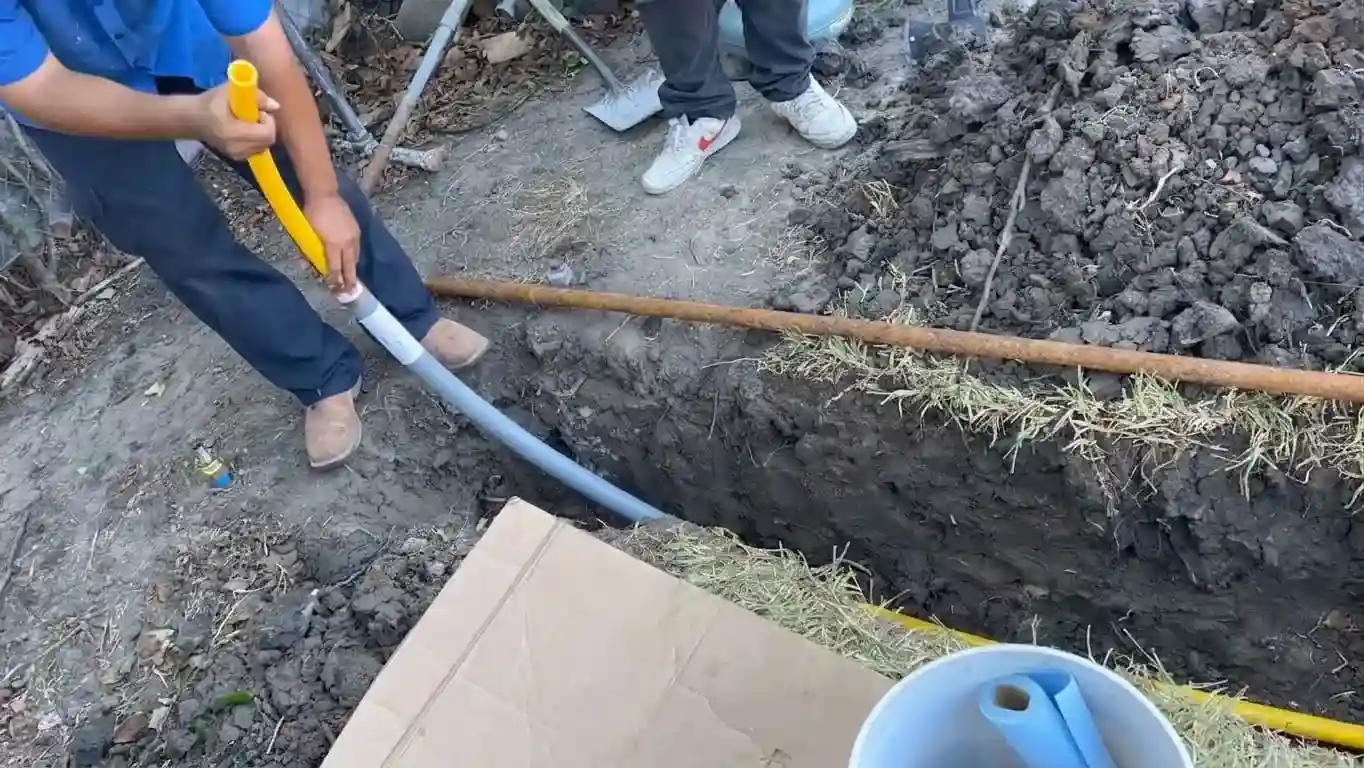 Trenched to depth, bedded clean
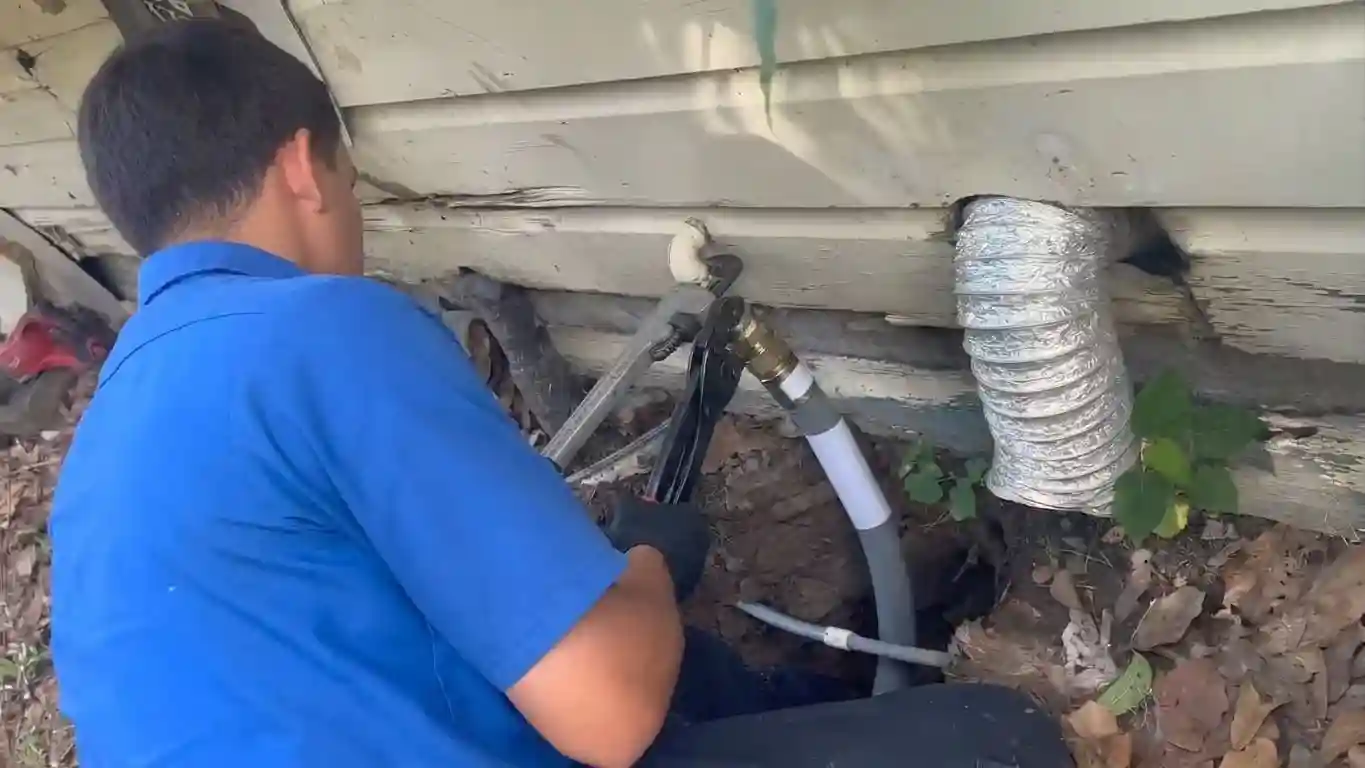 The foundation entry — sleeved, sealed, done right
Where the line meets the house
The transition points are where rushed underground installs fail: the riser where buried PE turns to steel and surfaces, and the foundation penetration where the line enters the building. Ours get proper risers at both ends of the buried run and a sealed sleeve through the foundation — because soil moves, concrete doesn’t, and the pipe between them needs protecting from the argument.
- ✓Riser transitions at both ends — PE stays buried where it belongs; steel handles the above-ground world.
- ✓Sleeved foundation entry — the five-dollar part that prevents the settling crack from becoming a gas problem.
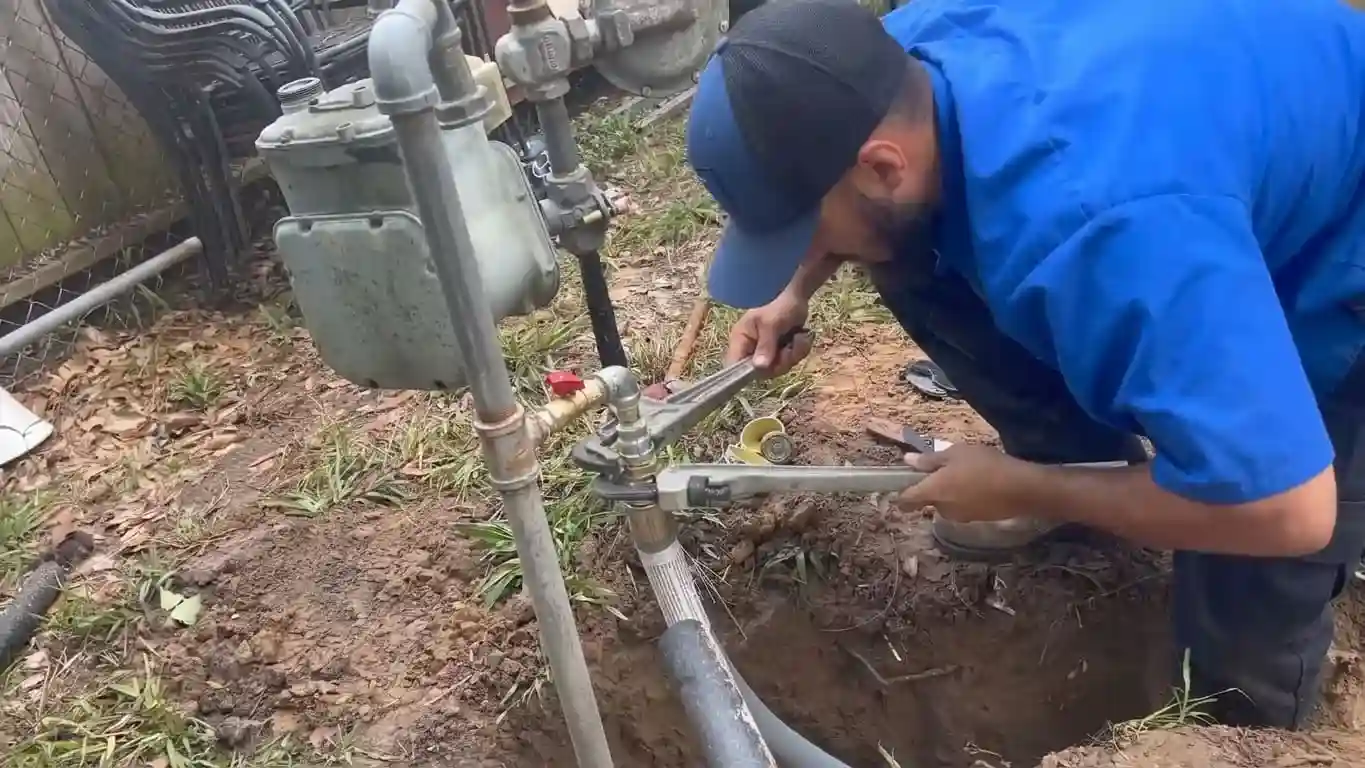 The meter: the one part we coordinate, not install
Will Your Meter Handle the New Load?
Here’s the honest boundary no installer likes explaining: your meter belongs to Peoples Gas, and it has a maximum delivery rating like everything else. Add a tankless heater and a generator to a house metered decades ago and you can exceed what it delivers — every appliance in the house then competes for supply on the coldest morning of the year. When the load math says the meter’s the limit, we handle the utility coordination for the upgrade; the meter swap itself is their work, typically at little or no cost, on their schedule. Knowing that before installation day — instead of discovering it after — is exactly what the load calculation is for.
- ✓We run the total-load math first — existing appliances plus the new one, against the meter’s delivery rating.
- ✓We file the utility request when needed — and sequence the install so you’re never left half-connected waiting on a meter.
The Fittings That Decide Whether It Lasts
A new gas line is a chain of thirty small decisions. The drip leg that catches sediment before it reaches your appliance valve. The union placed where future service will need it. The shutoff that’s actually reachable. Gas-rated thread compound — the expensive kind that’s good for fifty years — on every joint. None of it shows in the quote’s bottom line; all of it shows in year fifteen.
- ✓Drip leg at every appliance — the short capped stub that catches debris and moisture. Inspections look for it; shortcut installs skip it.
- ✓Assemblies bench-built first — manifolds and multi-fitting sections built and checked on the pipe vice, so what’s installed is already proven.
- ✓Serviceability built in — unions and shutoffs placed for the next tech, even if the next tech is us in 2046.
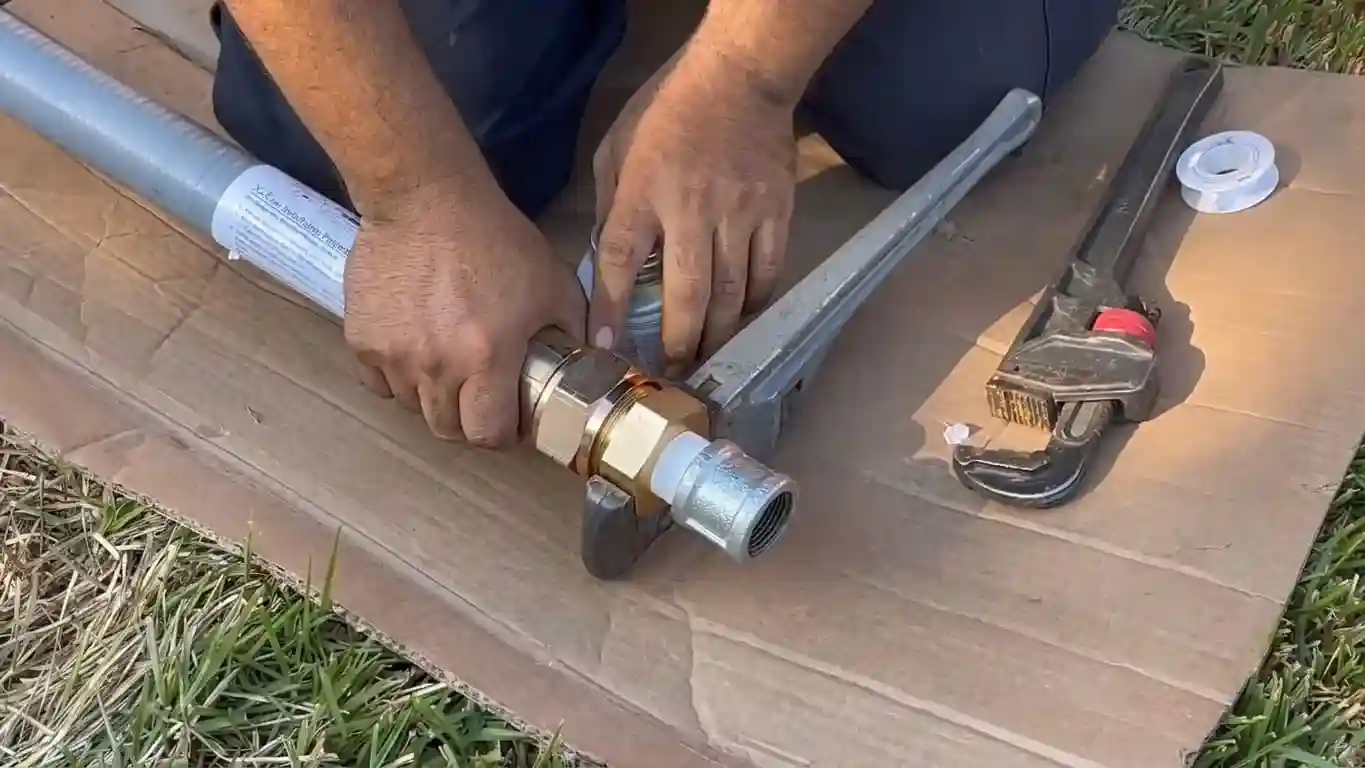 Fittings assembled on the bench, proven before install
Gas Line Installation Chicago Cost: By the Foot, Honestly
Install pricing is mostly geometry: how far the gas has to travel and what’s between here and there. The Chicago market runs roughly $25–$45 per linear foot installed — here’s how that lands by job type, permit included in every number’s fine print because we pull it every time.
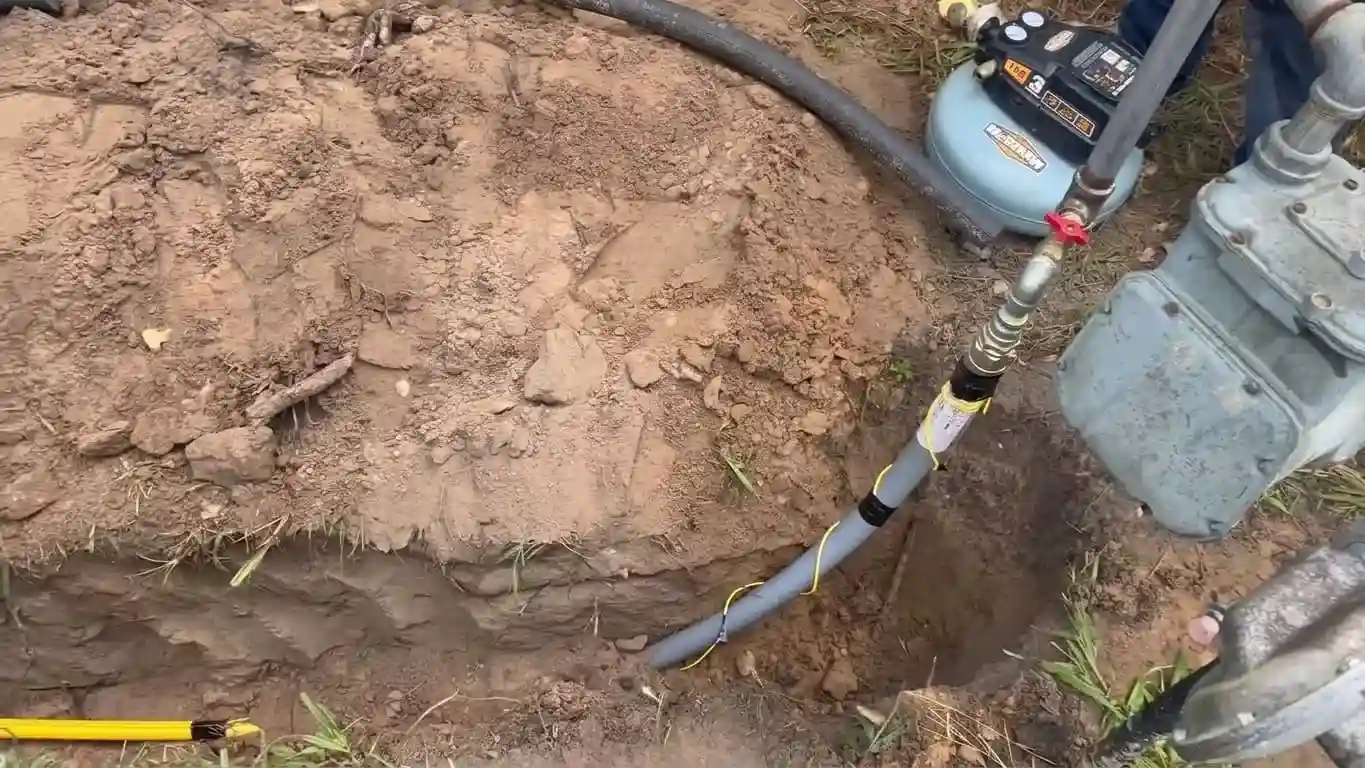 Every quote ends the same way: a gauge, holding
| Install type | Typical Chicago range |
|---|---|
| Short interior branch to one appliance (under ~20 ft) | $269 – $850 — Chicago average $559 |
| Rule-of-thumb, any run | $25 – $45 per linear foot, materials + labor |
| Medium runs through floors/walls (20–50 ft) | $850 – $2,500 |
| Long or underground runs (garage, grill, generator) | $1,500 – $5,000 depending on trenching |
| Upsizing existing pipe for tankless/generator | +$400 – $1,200 where the load math requires it |
| Chicago gas piping permit | ~$75 — pulled by us, every job |
| Pressure test, inspection coordination & documentation | Included — not line items |
What moves an install quote up or down
| Factor | Pushes cost down | Pushes cost up |
|---|---|---|
| Run length | Appliance near existing piping | Opposite end of the house, detached structures |
| Access | Open basement ceiling, exposed routing | Finished walls, tight chases, slab sections |
| Appliance demand | Small load on a line with headroom | Tankless or generator forcing upsized pipe |
| Excavation | None | Trenching, hardscape crossings, restoration |
| Existing system | Sound piping to build from | Galvanized or corroded pipe that shouldn’t carry new load |
| Season | Grill lines booked in spring, generators before storm season | Frozen-ground digs and the fall equipment rush |
Installation Case Studies From Real Chicago Patterns
Representative cases from the installs this city orders on repeat — every Chicago gas line installation below follows the same arc: situation, sizing, install, outcome. Yours is probably on this list.
Electric to gas, mid-remodel
SituationFull kitchen gut, homeowner switching to a 60,000-BTU dual-fuel range — no gas in the kitchen, walls open for three more weeks.
SizingLoad check confirmed headroom on the basement main; short 1/2″ branch up through the open wall.
InstallBranch run and supported, shutoff behind the range, drip leg at the drop, permit and inspection inside the reno’s window.
OutcomeTested, inspected, and burning blue before the drywall crew arrived.
The tankless that needed real pipe
SituationPlumber quoted a 199k-BTU tankless swap; the existing 1/2″ line had fed a 40k tank since the Daley years. Nobody had mentioned pipe.
SizingLoad math said it plainly: five times the demand needs the 3/4″ run the house never had.
InstallUpsized supply from the meter side, new drip leg and shutoff at the unit, coordinated with the plumber’s schedule.
OutcomeFull flow at full fire — no error codes, no starved winter showers.
Sixty feet of buried heat
SituationWoodshop in an unheated garage, sixty feet from the house, owner done with Chicago winters killing the hobby.
Sizing50k-BTU heater at sixty feet: run length drove the size, not the unit.
InstallJULIE locate, trench below frost influence, PE with tracer wire, risers both ends, sleeved wall entry, careful backfill.
OutcomeHeat at the flip of a switch; lawn seam gone by summer.
The generator and the meter question
SituationStandby generator purchase after one too many outages — 150k BTU asking a 1990s meter for more than everything else combined.
SizingTotal-load math flagged the meter before installation day, not after.
InstallUtility upgrade request filed and sequenced first; then the 1″-to-3/4″ run, dedicated shutoff, test, inspection.
OutcomeFirst outage of the winter: lights on in eight seconds, neighbors in the dark.
How to Vet Any Installer — Including Us
The best gas line installation Chicago can buy is the one you can verify before it’s buried in your wall. Our review pages go live with the business — every review from a real Chicago address. Until then: the six questions that sort gas fitters from guys with a pipe wrench.
1. “Show me the load calculation.”
Pipe size should come from BTUs and run length, on paper. “Half-inch is always fine” is how tankless units starve.
2. “Is the permit filed before you start?”
Before pipe, always. Unpermitted gas work surfaces at your insurance claim and your closing — the two worst possible moments.
3. “Drip legs and shutoffs included?”
At every appliance, per code. If the quote doesn’t know what a drip leg is, the inspection will teach everyone.
4. “Can I watch the pressure test?”
Yes should be instant. A new line that’s never held test pressure in front of you is a promise, not an installation.
5. “Tracer wire on the buried run?”
Modern PE with tracer wire is the standard. Buried pipe nobody can ever locate again is a gift to the next excavator’s insurance company.
6. “Who handles the meter question?”
The right answer: “We run the math and coordinate Peoples Gas if the meter needs upsizing.” Blank stare = your homework later.
Who Should Run Your New Gas Line? The Real Options
Including the option that shows up free with your new dryer — and why “free” is doing a lot of work in that sentence.
| What matters | GasGuard Chicago | Appliance-store installer | General HVAC co. | Handyman / DIY |
|---|---|---|---|---|
| Runs new gas piping legally | ✓ Licensed for exactly this | ✗ Connects to existing only — and walks if anything’s off | ~ If properly licensed | ✗ Illegal on gas in Chicago |
| Load calculation & pipe sizing | ✓ On paper, shown to you | ✗ Not their job | ~ Sometimes | ✗ |
| Permit & inspection as standard | ✓ Filed before pipe, ~$75 | ✗ | ~ “If you want” | ✗ Never |
| Pressure test before light-off | ✓ Twice — watch the gauge | ~ Bubble-checks the connector | ~ Varies by crew | ✗ |
| Publishes real pricing | ✓ This page, by the foot | ✓ Free* (*see every asterisk) | ✗ “Call for quote” | ~ Cash number, no paper |
Fair credit where due: the appliance-store installer is fine at exactly one thing — connecting a new unit to a correct, existing line. When there’s no line, or the line’s wrong, that’s this page. And if what you actually have is a leak on old piping, that’s our gas leak repair services Chicago team — different job, same standards.
Gas Line Installation in Chicago: Questions, Answered
How much does it cost to install a gas line in Chicago?
Short interior branches to one appliance run $269–$850 (Chicago average $559). The market rule of thumb is $25–$45 per installed foot, so medium runs land $850–$2,500 and long or underground runs $1,500–$3,500 for garage & grill runs; $2,000–$5,000 for standby generators with trenching. Permit’s about $75 and we pull it every job; pressure testing and documentation are included, not line items.
Do I need a permit to add a gas line in Chicago?
Yes — every new gas line in Chicago requires a permit and inspection. It’s roughly $75, and we file it before pipe is cut. Skipping it doesn’t save money; it defers the cost to your insurance claim or your closing, with interest.
How long does a gas line installation take?
A short interior branch: usually half a day of pipe work. Medium runs through finished spaces: a full day. Underground runs to a garage or grill: one to two days including trenching. Add the inspection window before first light-off — we schedule it when we file the permit so it lands, not lingers.
Can the appliance delivery crew hook up my gas?
To an existing, correct line — usually yes, that’s their lane. What they can’t do is run new piping, upsize an undersized line, or fix anything wrong they find; most are instructed to walk away from any of it. If your delivery got refused at the connection step, that’s the call we get weekly.
Is a natural gas grill line worth it versus propane tanks?
If you grill more than occasionally, yes — a one-time install ($269–$850 typical for a patio run, more if trenching is long) ends tank swaps forever, burns cheaper per BTU, and never dies mid-brisket. Book it in spring; grilling season is our version of the November rush.
Why does a tankless water heater need a bigger gas line?
Because it heats water on demand instead of slowly: a tankless pulls 150,000–199,000 BTU while firing — three to five times the 40,000-BTU tank it replaces. The 1/2″ line that fed the tank for decades physically cannot deliver that; upsizing to 3/4″ or 1″ is normal and belongs in the quote upfront, not the change order after.
How deep does a buried gas line need to be in Chicago?
Typically 18–24 inches or deeper — below the zone the freeze-thaw cycle churns. Just as important as depth: modern PE pipe with tracer wire, clean bedding, riser transitions at both ends, and a JULIE (811) locate before any digging. Depth without those details is just a deeper future problem.
What’s a drip leg, and do I really need one?
The short capped stub of pipe below each appliance connection — it catches sediment and moisture before they reach the appliance valve. Code expects it, inspectors look for it, and appliances fed without one wear their valves out early. It costs a few dollars of pipe; we install it at every connection, always.
Can you run gas to a detached garage or coach house?
Yes — it’s one of our most common installs. The run goes underground: trenched to depth, PE with tracer wire, risers at both ends, sleeved where it enters the structure. Sixty feet to a garage typically lands $1,500–$3,500 with trenching, quoted before the shovel touches grass.
Who upgrades the meter if my new appliance needs more gas?
Peoples Gas owns and swaps the meter — typically at little or no cost, on their schedule. Our job is catching the capacity issue in the load calculation before install day and filing the coordination so you’re never half-connected waiting. Generators and tankless units are the usual triggers.
Can I install a gas line myself if I’m handy?
Not legally in Chicago — gas piping requires a licensed contractor and a permit, full stop. Beyond legality: sizing math, test pressures, bonding, and drip legs are where handy meets hazardous. DIY the shelving; hire the gas line.
What happens at the city inspection?
The inspector verifies the permit matches the work, checks sizing, support, shutoffs, and drip legs, and confirms the line held its pressure test. Because we build to that checklist from step one, our inspections are appointments, not events — and your paperwork is done the same day.
What if you find a leak on my existing piping during the install?
You get the finding, the reading, and the honest options — before we proceed. New lines don’t get connected to failing systems. Repairs are quoted separately by the gas leak repair Chicago, IL team using the published tiers on our gas line repair page, so an install never becomes a blank check.
Do you install lines for fireplaces and log sets?
Yes — fireplace log sets, inserts, and freestanding stoves, with the key valve and sizing the burner requires. Same rules as everything on this page: permit, test, inspection, documentation. Book before the first cold snap; hearth season and furnace season arrive together.
Gas line installation Across Chicago’s Neighborhoods
Every job on this page runs the same across the city — and these neighborhoods have dedicated pages covering exactly how their housing stock behaves: Lakeview, Lincoln Park, Portage Park, Bridgeport, McKinley Park, Beverly, Morgan Park, Hyde Park, Logan Square, Avondale, Rogers Park, Edgewater, Jefferson Park, North Center, Albany Park, and Wicker Park. Anywhere else in Chicago: same published pricing, same-day response — one call covers the whole city.
Run It Once. Run It Right.
A new range, a tankless upgrade, backyard heat, or a generator that ends the outage anxiety — every new line gets the same treatment: sized on paper, permitted before pipe, tested before flame, documented forever.
☎ Call (773) 200-2148 — Free Install Quotes Licensed & insured in Illinois • Chicago-only service • Permit, pressure test & documentation included